Concept 2: Q-Learning and Value Functions
Q-Learning and Value Functions
ℹ️ Definition Q-Learning is a model-free reinforcement learning algorithm that learns the value of taking each action in each state, enabling an agent to discover optimal policies without needing a model of the environment.
Learning Objectives
By the end of this lesson, you will:
- Understand the concept of value functions (V and Q)
- Learn the Bellman equation and its role in RL
- Implement tabular Q-Learning from scratch
- Apply epsilon-greedy exploration strategy
- Visualize Q-table convergence and learned policies
- Tune hyperparameters (learning rate, discount factor, epsilon)
Introduction
In Lesson 1, we saw how a random agent performs poorly on RL tasks like CartPole. The agent had no way to learn which actions were good or bad in different situations. Q-Learning solves this by learning a value function that estimates how good each action is in each state.
Think of Q-Learning as building a "cheat sheet" for the environment:
- State: "I'm at the intersection"
- Action: "Turn left"
- Q-value: "This action is worth 8.5 points"
By building this cheat sheet through experience, the agent can make informed decisions.
Value Functions
State-Value Function V(s)
The state-value function V(s) tells us "how good is it to be in state s?"
Mathematically:
scss
V(s) = Expected total reward starting from state s and following policy π
Example - Chess:
- V(winning position) = High (close to victory)
- V(losing position) = Low (close to defeat)
- V(equal position) = Medium (game could go either way)
Action-Value Function Q(s,a)
The action-value function Q(s,a) tells us "how good is it to take action a in state s?"
Mathematically:
css
Q(s,a) = Expected total reward starting from state s, taking action a, then following policy π
Key difference: V(s) evaluates states, Q(s,a) evaluates state-action pairs.
Example - Chess:
- Q(current_position, "move_queen_to_e5") = 7.2
- Q(current_position, "move_pawn_to_a4") = 3.1
- Q(current_position, "castle_kingside") = 8.9
The agent chooses the action with highest Q-value (castle kingside).
The Bellman Equation
The Bellman equation is the fundamental relationship in RL. It expresses value functions recursively.
Bellman Equation for Q-values
css
Q(s, a) = R(s,a) + γ * max_a' Q(s', a')
Where:
- Q(s,a): Value of taking action a in state s
- R(s,a): Immediate reward for taking action a in state s
- γ (gamma): Discount factor (0 <= γ <= 1)
- s': Next state after taking action a
- max_a' Q(s', a'): Maximum Q-value in next state (over all possible actions)
Intuition
The value of an action = immediate reward + discounted value of best future action
Example - Video Game:
ini
Q(here, go_right) = +5 (collect coin) + 0.9 * max(Q(next_room, all_actions))
                  = +5 + 0.9 * 10
                  = +5 + 9
                  = 14
Why Discount Factor γ?
The discount factor determines how much we value future rewards:
- γ = 0: Only care about immediate reward (myopic)
- γ = 0.5: Future rewards worth 50% of immediate rewards
- γ = 0.9: Value future highly (common in practice)
- γ = 0.99: Value future very highly (for long-term planning)
- γ = 1: No discounting (problematic for infinite horizons)
Example:
ini
Immediate reward: $100
Reward in 1 step: $100
Reward in 2 steps: $100

With γ=0.9:
Total value = 100 + 0.9*100 + 0.9²*100 = 100 + 90 + 81 = 271

With γ=0.5:
Total value = 100 + 0.5*100 + 0.5²*100 = 100 + 50 + 25 = 175
Q-Learning Algorithm
Q-Learning learns Q-values through experience using temporal difference (TD) learning.
The Q-Learning Update Rule
python
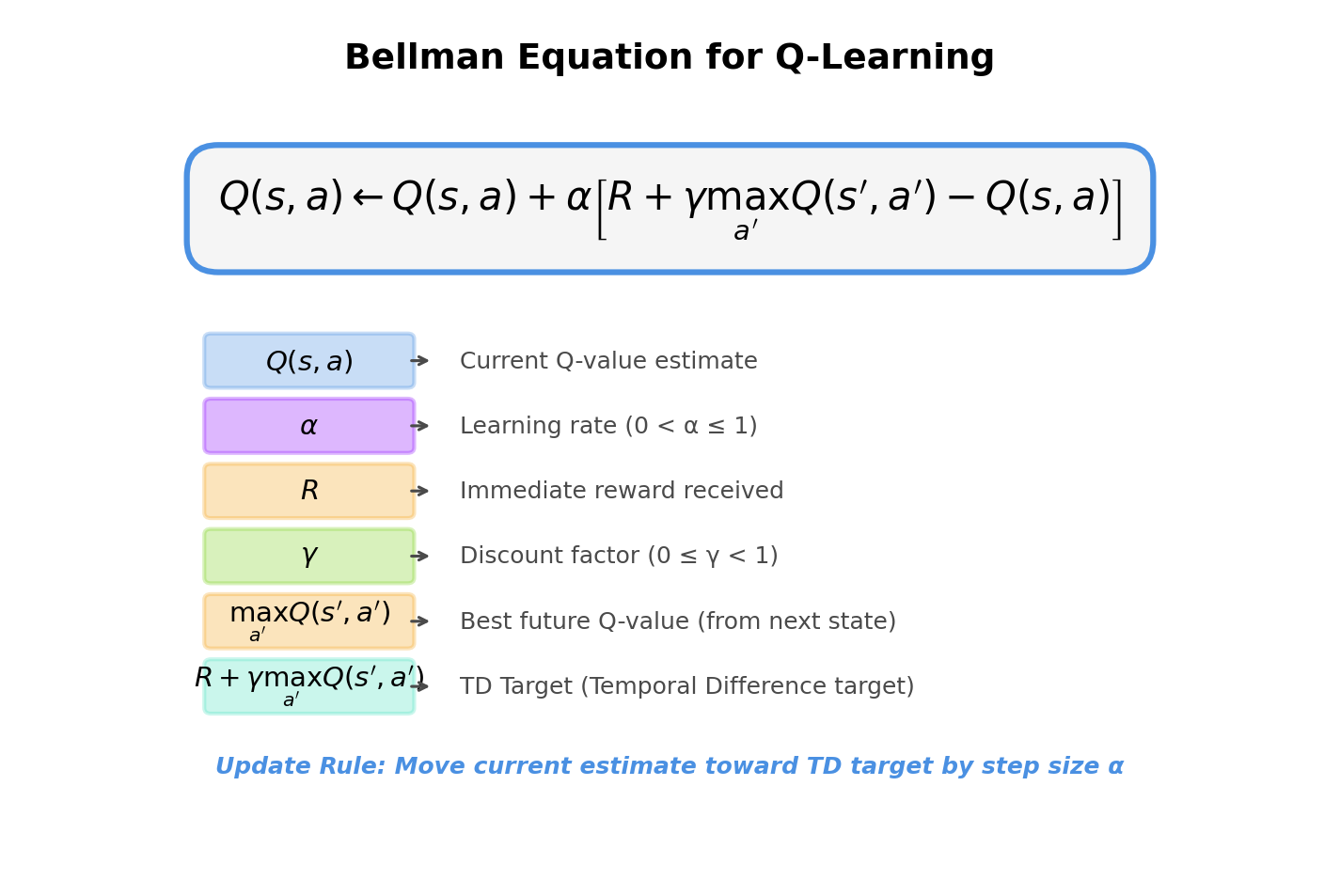
Q(s,a) ← Q(s,a) + α * [R + γ * max_a' Q(s',a') - Q(s,a)]
Where:
- α (alpha): Learning rate (0 < α <= 1)
- R: Observed reward
- TD Target: R + γ * max_a' Q(s',a')
- TD Error: [TD Target - Q(s,a)]
Intuition
- Current estimate: Q(s,a)
- New information: R + γ * max Q(s',a')
- Error: How wrong was our estimate?
- Update: Move toward new information by learning rate α
Analogy - Learning Restaurant Quality:
- Current belief: Restaurant is 7/10
- You visit and have experience worth 9/10
- Error: +2 points
- Update with α=0.1: 7 + 0.1*(9-7) = 7.2
Tabular Q-Learning
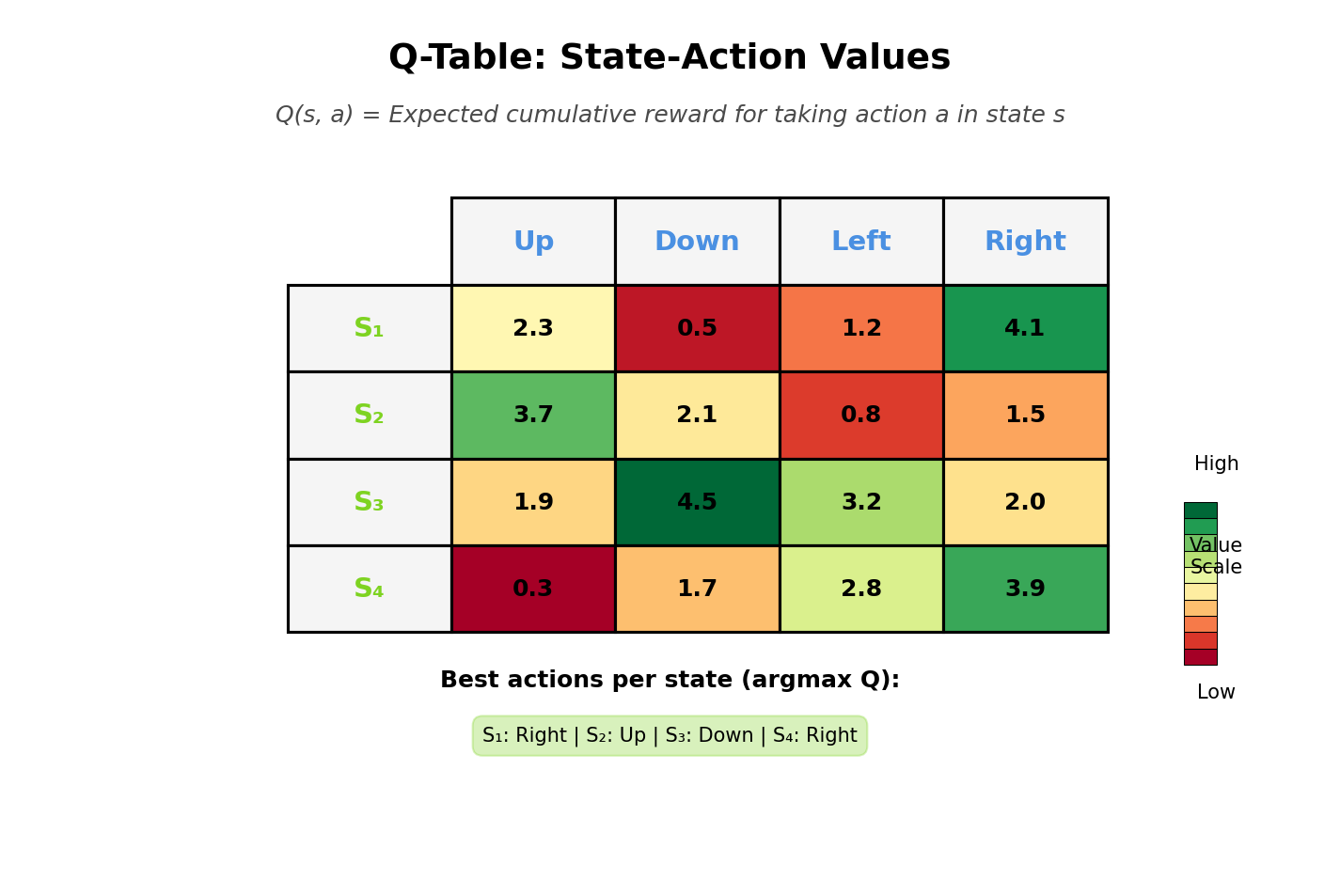
For small state/action spaces, we use a Q-table:
| Action 0 | Action 1 | Action 2 | Action 3 | |
|---|---|---|---|---|
| State 0 | 0.0 | 0.0 | 0.0 | 0.0 |
| State 1 | 0.0 | 0.0 | 0.0 | 0.0 |
| State 2 | 0.0 | 0.0 | 0.0 | 0.0 |
| ... | ... | ... | ... | ... |
After learning:
| Action 0 | Action 1 | Action 2 | Action 3 | |
|---|---|---|---|---|
| State 0 | 3.2 | 5.7 | 2.1 | 4.8 |
| State 1 | 7.3 | 2.4 | 8.9 | One.2 |
| State 2 | One.5 | 9.2 | 3.7 | 6.4 |
The agent selects actions with highest Q-values (after learning).
Exploration vs Exploitation
Q-Learning must balance:
- Exploitation: Choose action with highest known Q-value
- Exploration: Try other actions to discover better options
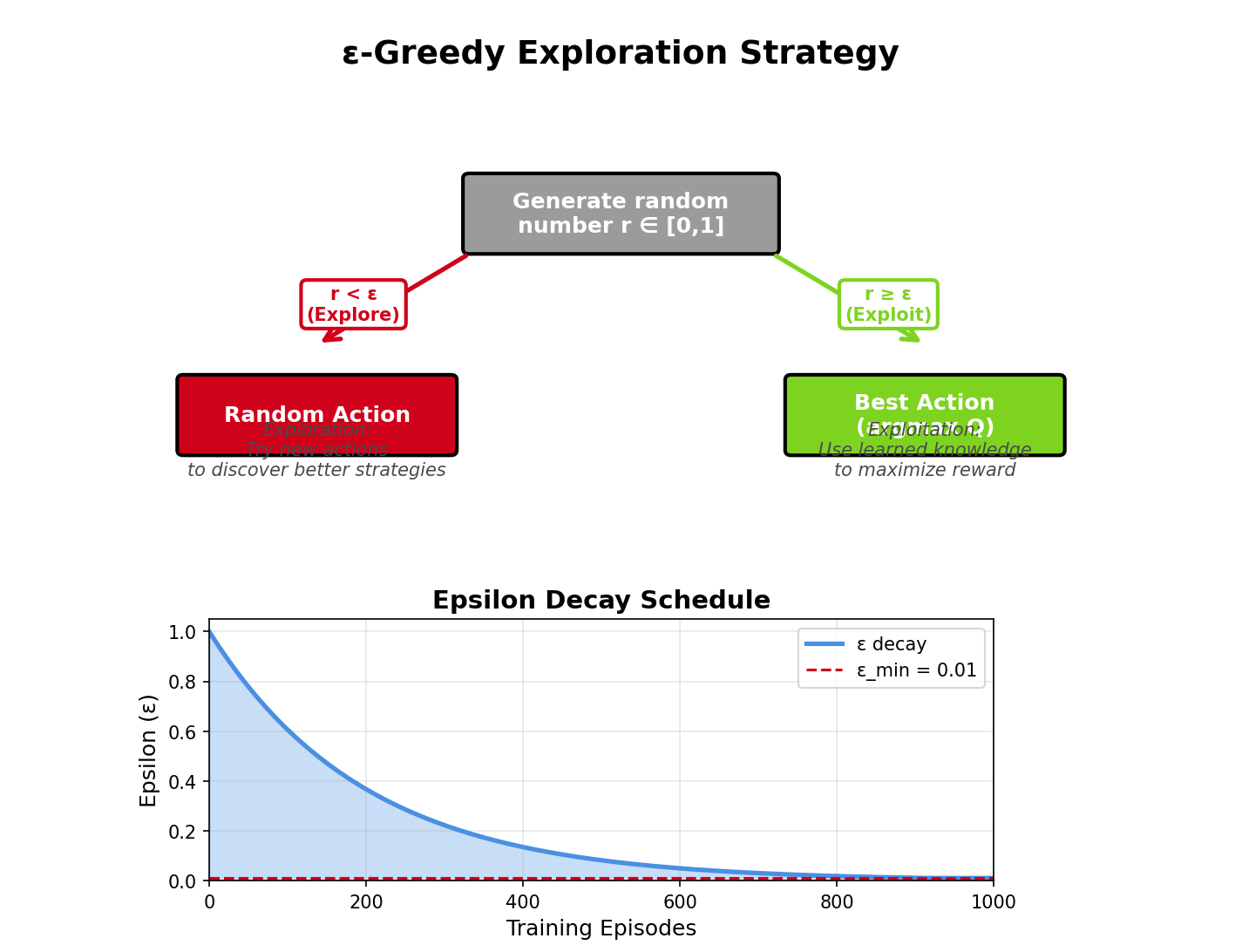
Epsilon-Greedy Strategy
The most common exploration strategy:
python
if random() < epsilon:
    action = random_action()  # Explore
else:
    action = argmax(Q[state])  # Exploit
Parameters:
- ε = 1.0: Pure exploration (random)
- ε = 0.5: 50% explore, 50% exploit
- ε = 0.1: 10% explore, 90% exploit (common)
- ε = 0.0: Pure exploitation (no learning)
Epsilon Decay
Often, we start with high ε (exploration) and gradually reduce it (exploitation):
python
epsilon = epsilon_start * (epsilon_decay ** episode)
Example:
yaml
Episode 0: ε = 1.0 (explore)
Episode 100: ε = 0.5 (balanced)
Episode 500: ε = 0.1 (mostly exploit)
Episode 1000: ε = 0.01 (minimal exploration)
Q-Learning Algorithm (Complete)
python
Initialize Q(s,a) arbitrarily for all s,a
Set hyperparameters: α, γ, ε

For each episode:
    Initialize state s

    While episode not done:
        # Choose action using ε-greedy
        if random() < ε:
            a = random_action()
        else:
            a = argmax_a Q(s,a)

        # Take action, observe reward and next state
        s', r = env.step(a)

        # Q-Learning update
        Q(s,a) = Q(s,a) + α * [r + γ * max_a' Q(s',a') - Q(s,a)]

        # Move to next state
        s = s'

    # Decay epsilon
    ε = ε * decay_rate
Example: FrozenLake Environment
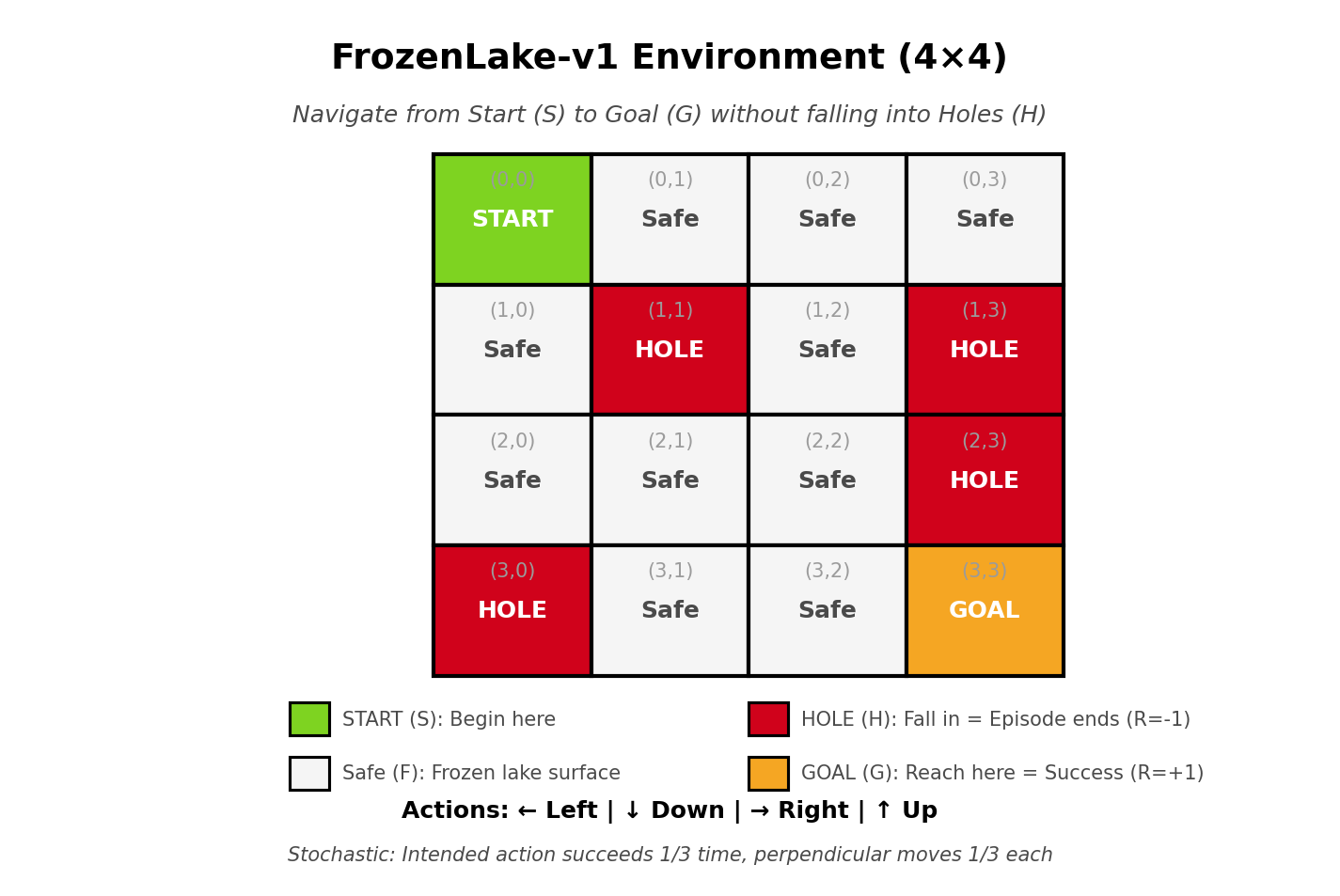
FrozenLake is a 4x4 grid world perfect for learning Q-Learning:
r
S F F F
F H F H
F F F H
H F F G
- S: Start position
- F: Frozen surface (safe)
- H: Hole (fall in, episode ends, reward = 0)
- G: Goal (reward = +1)
Challenge: The ice is slippery! When you try to move in a direction, you might slip to adjacent cells.
States: 16 grid positions (0-15) Actions: 4 (Left=0, Down=1, Right=2, Up=3) Rewards: +1 for reaching goal, 0 otherwise
Learning Process
Episode 1: Random walk, fall in hole, Q-table stays mostly zeros.
Episode 10: Some positive Q-values near goal start appearing.
Episode 100: Q-values propagate backward from goal.
Episode 1000: Optimal path learned, agent reaches ``goal >70``% of the time.
Hyperparameters and Tuning
Learning Rate (α)
Controls how much we update Q-values:
- α = 0.01: Very slow learning (conservative updates)
- α = 0.1: Moderate learning (common default)
- α = 0.5: Fast learning (aggressive updates)
- α = 1.0: Replace old value completely (often too aggressive)
Too low: Learning is slow, may not converge in reasonable time. Too high: Unstable learning, Q-values oscillate wildly.
Discount Factor (γ)
Controls future reward valuation:
- γ = 0.9: Standard for episodic tasks
- γ = 0.95: Value future more
- γ = 0.99: Long-term planning
- γ = 1.0: Infinite horizon (use carefully)
Too low: Myopic behavior, agent only optimizes immediate rewards. Too high: Slow value propagation, requires more episodes.
Epsilon (ε)
Controls exploration:
- Start high (ε=1.0): Explore environment initially
- Decay gradually: Balance exploration and exploitation
- End low (ε=0.01-0.1): Mostly exploit learned policy
Decay too fast: Agent commits to suboptimal policy. Decay too slow: Wastes time exploring when policy is already good.
Convergence and Optimality
Convergence Guarantees
Q-Learning is guaranteed to converge to optimal Q-values if:
- All state-action pairs are visited infinitely often
- Learning rate α decays appropriately (Σα = ∞, Σα² < ∞)
In practice, we use constant α and sufficient exploration (ε-greedy), which works well empirically.
Signs of Convergence
- Q-values stabilize: Changes become very small
- Policy stabilizes: Agent consistently chooses same actions
- Performance plateaus: Average reward stops improving
Monitoring Learning
Track these metrics:
- Average reward per episode (should increase)
- Q-value magnitude (should stabilize)
- Policy entropy (should decrease as policy becomes more deterministic)
- Exploration rate (epsilon decay)
Q-Learning vs Other Algorithms
| Aspect | Q-Learning | SARSA | Monte Carlo |
|---|---|---|---|
| Learning | Off-policy | On-policy | On-policy |
| Update | TD (temporal difference) | TD | Full episode |
| Target | max_a Q(s',a') | Q(s',a') from policy | Actual return G |
| Optimism | Optimistic (learns optimal policy) | Conservative (learns followed policy) | Exact (uses real returns) |
| Speed | Fast | Fast | Slow (needs full episode) |
Advantages of Q-Learning
- Model-free: No need to know environment dynamics
- Off-policy: Learns optimal policy while exploring
- Simple: Easy to understand and implement
- Guaranteed convergence: Under mild conditions
- Works well: For small state/action spaces
Limitations of Q-Learning
- Curse of dimensionality: Q-table explodes with state/action size
- Discrete spaces only: Can't handle continuous states/actions directly
- Sample inefficiency: Needs many experiences to converge
- No generalization: Each state learned independently
Solution: Deep Q-Networks (DQN) - Next lesson!
Applications
Classic Control
- CartPole balancing
- Mountain car
- Acrobot
Grid Worlds
- Navigation tasks
- Maze solving
- Pathfinding
Simple Games
- Tic-tac-toe
- Connect Four (with abstraction)
- Simple Atari games (discretized)
Robotics (Discretized)
- Pick and place (discretized positions)
- Simple navigation
- Task switching
Key Takeaways
- Value functions estimate goodness of states (V) or state-action pairs (Q)
- Bellman equation expresses recursive relationship between values
- Q-Learning learns Q-values through TD updates
- Epsilon-greedy balances exploration and exploitation
- Hyperparameters (α, γ, ε) significantly affect learning
- Tabular Q-Learning works for small discrete spaces
- Next step: Deep Q-Networks for complex environments
Looking Ahead
In the next lesson, we'll extend Q-Learning to handle:
- High-dimensional states: Images, continuous values
- Large state spaces: Millions of possible states
- Function approximation: Neural networks instead of tables
- Experience replay: Learning from past experiences
- Target networks: Stabilizing training
Get ready to train agents that play Atari games from pixels!
Summary
- Q-Learning learns action values Q(s,a) through experience
- Bellman equation is the foundation of value-based RL
- TD learning updates Q-values using one-step lookahead
- Epsilon-greedy exploration ensures we find optimal policies
- Hyperparameters (α, γ, ε) control learning speed and quality
- Tabular Q-Learning is limited to small discrete state spaces
- DQN (next lesson) extends Q-Learning to complex domains