Concept 1: Introduction to Reinforcement Learning
Reinforcement Learning
ℹ️ Definition Reinforcement Learning (RL) is a machine learning paradigm where an agent learns to make optimal decisions by interacting with an environment and receiving rewards or penalties for its actions.
Learning Objectives
By the end of this lesson, you will:
- Understand what Reinforcement Learning is and how it differs from supervised/unsupervised learning
- Learn the key components of RL: agent, environment, state, action, and reward
- Understand the concept of Markov Decision Processes (MDPs)
- Implement a basic agent-environment interaction loop
- Visualize agent performance over multiple episodes
Introduction
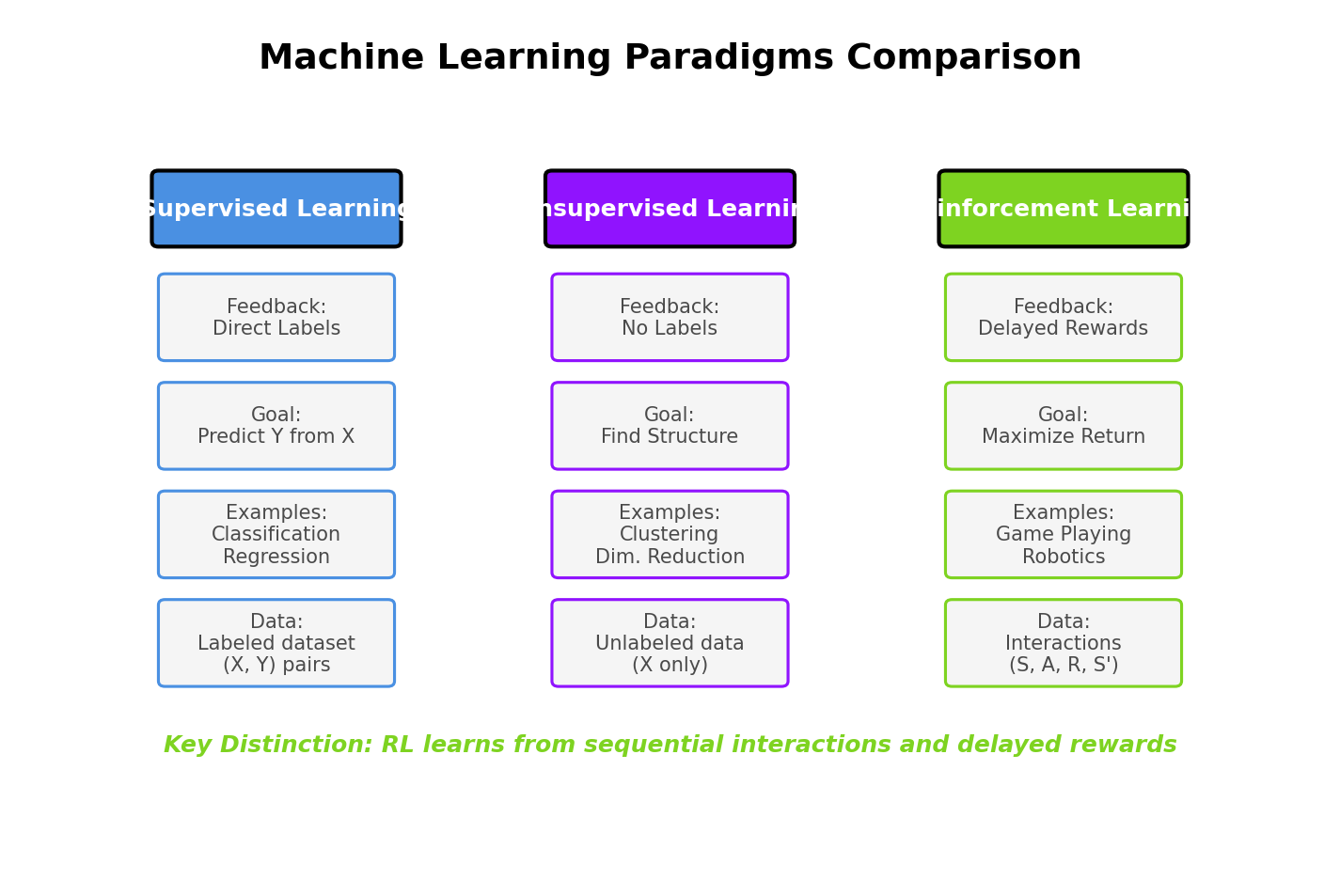
In the AI courses you've taken so far, you've learned about supervised learning (learning from labeled examples) and unsupervised learning (finding patterns in unlabeled data). Reinforcement Learning introduces a completely different paradigm: learning through trial and error.
Imagine teaching a dog to fetch. You don't show the dog thousands of labeled examples of "correct fetch" vs "incorrect fetch." Instead, the dog tries different behaviors, and you reward it when it does something right. Over time, the dog learns which actions lead to rewards. This is the essence of reinforcement learning.
The RL Framework
Agent and Environment
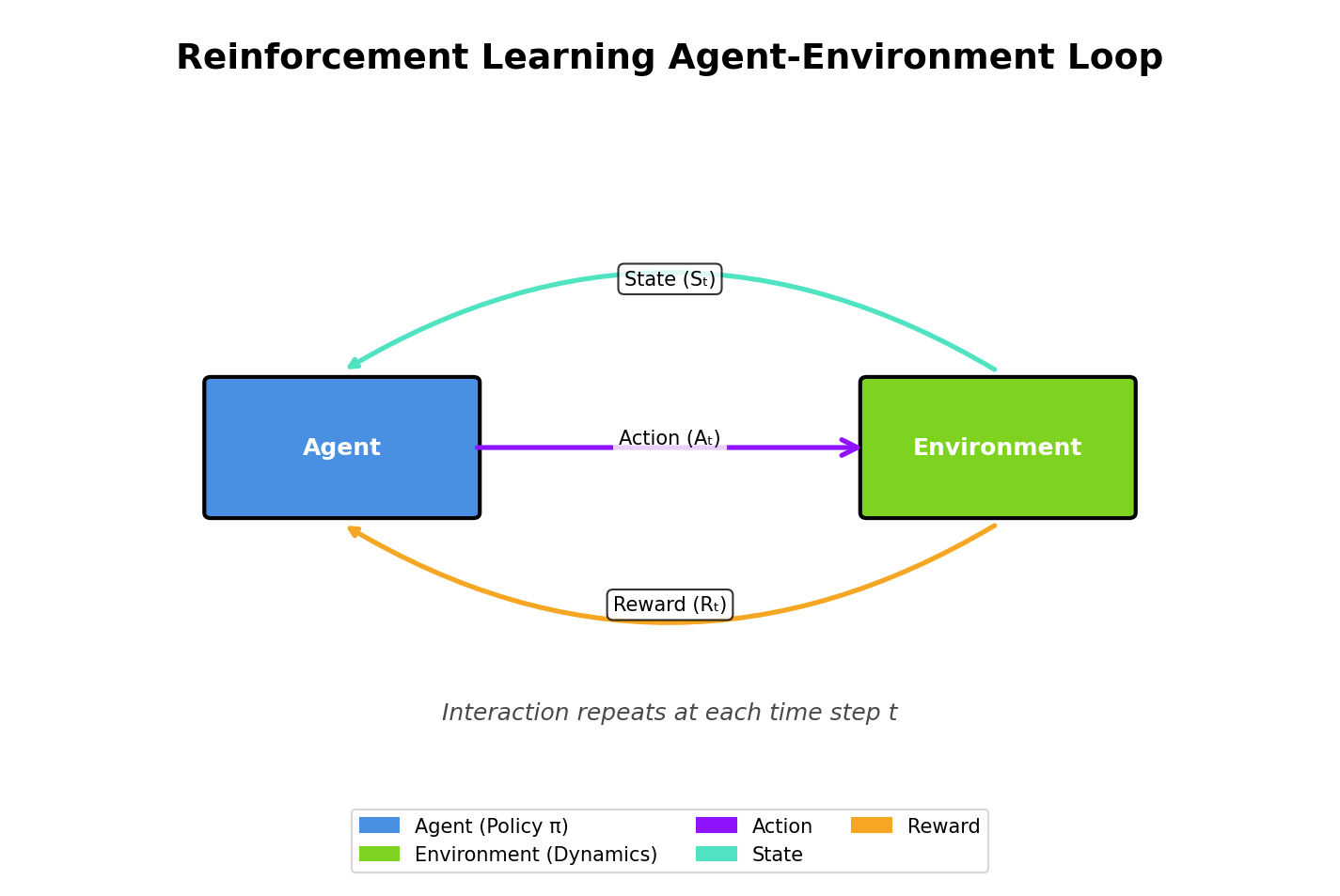
RL involves two main components interacting over time:
- Agent: The learner or decision maker (e.g., a robot, game-playing AI, recommendation system)
- Environment: Everything the agent interacts with (e.g., game world, physical world, user behavior)
At each time step:
- The agent observes the current state of the environment
- The agent chooses an action to take
- The environment transitions to a new state
- The agent receives a reward signal
- The cycle repeats
Key Components Explained
One. State (S)
A description of the current situation.
Examples:
- Chess: Current positions of all pieces on the board
- Self-driving car: Sensor readings, speed, location, nearby objects
- Stock trading: Current prices, portfolio holdings, market indicators
2. Action (A)
A decision the agent can make to interact with the environment.
Examples:
- Chess: Move a specific piece to a specific square
- Self-driving car: Accelerate, brake, turn left, turn right
- Stock trading: Buy stock, sell stock, hold
3. Reward (R)
A scalar feedback signal indicating how good or bad the action was.
Examples:
- Chess: +1 for winning, -1 for losing, 0 otherwise
- Self-driving car: +1 for staying in lane, -100 for collision, -1 for slow speed
- Stock trading: Profit or loss from the trade
💡 Key Insight: The agent doesn't know which actions are best initially. It must discover good actions through experience by trying actions and observing rewards.
The Goal of RL
The agent's goal is to learn a policy (π) - a strategy for choosing actions - that maximizes the cumulative reward over time.
- Policy: A mapping from states to actions (π: S -> A)
- Return (G): Sum of all future rewards (often discounted)
Markov Decision Process (MDP)
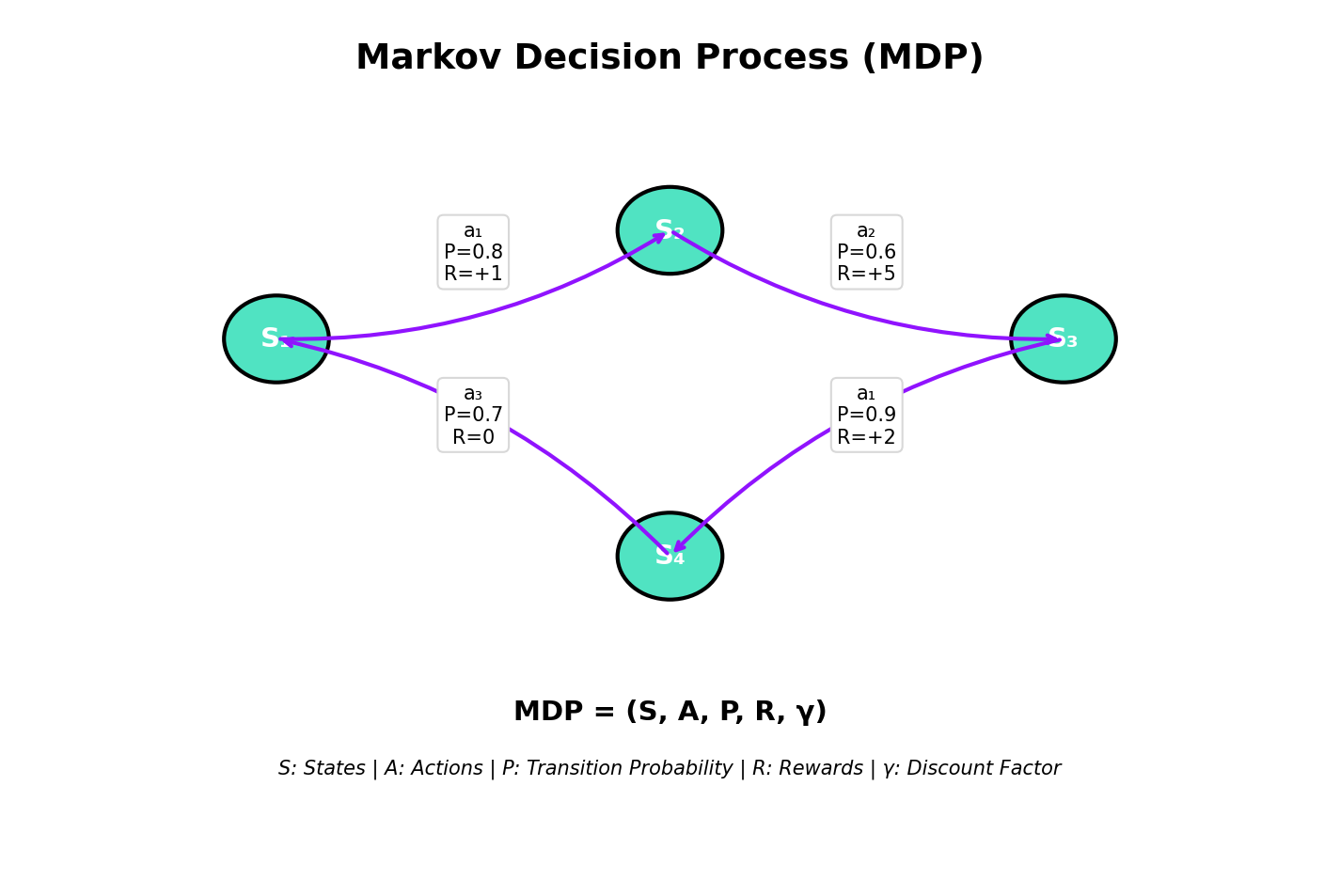
Most RL problems are formalized as Markov Decision Processes. An MDP has the Markov Property:
Markov Property: The future depends only on the current state, not on how we got there.
This means: Given the current state, the history of previous states doesn't matter for predicting what happens next.
Example - Chess:
- Markov: You only need to see the current board position to decide your next move
- Non-Markov: You would need to know the entire game history to decide
MDP Components
An MDP is defined by:
- S: Set of states
- A: Set of actions
- P: State transition probabilities P(s'|s,a) = probability of reaching state s' when taking action a in state s
- R: Reward function R(s,a,s') = reward received after taking action a in state s and reaching s'
- γ: Discount factor (0 <= γ <= 1) - how much we value future rewards
Episodic vs Continuing Tasks
Episodic Tasks:
- Have a defined ending (terminal state)
- Examples: Games (win/lose/draw), robot reaching a goal
Continuing Tasks:
- Run indefinitely
- Examples: Stock trading, process control, recommendation systems
Types of RL Algorithms
One. Model-Based vs Model-Free
Model-Based:
- Agent learns a model of the environment (how actions affect states)
- Uses the model to plan ahead
- Example: AlphaGo uses a model to simulate future game states
Model-Free:
- Agent learns directly from experience without modeling the environment
- Simpler but often requires more data
- Examples: Q-Learning, Policy Gradients (which we'll learn soon)
2. Value-Based vs Policy-Based
Value-Based:
- Learn the value of being in each state (or taking each action)
- Derive policy from values
- Examples: Q-Learning, DQN
Policy-Based:
- Learn the policy directly
- Examples: REINFORCE, PPO
3. On-Policy vs Off-Policy
On-Policy:
- Learn about the policy being used to make decisions
- Example: SARSA
Off-Policy:
- Learn about one policy while following another
- Example: Q-Learning
The Exploration-Exploitation Dilemma
One of the central challenges in RL:
- Exploitation: Use what you've learned to maximize immediate reward
- Exploration: Try new actions to discover better options
Example - Restaurant Choice:
- Exploit: Always go to your favorite restaurant (guaranteed satisfaction)
- Explore: Try new restaurants (might find something better, or worse)
Good RL agents must balance both. Common strategies:
- ε-greedy: With probability ε, choose random action (explore); otherwise, choose best known action (exploit)
- Upper Confidence Bound (UCB): Choose actions with uncertainty bonus
- Softmax: Choose actions probabilistically based on their estimated values
Real-World Applications of RL
One. Game Playing
- AlphaGo: Defeated world champion in Go
- OpenAI Five: Superhuman performance in Dota 2
- Atari Games: Human-level performance across 57 games
2. Robotics
- Robot manipulation: Grasping objects, assembly
- Locomotion: Walking, running, navigating obstacles
- Autonomous vehicles: Self-driving cars
3. Resource Management
- Data center cooling: Google reduced cooling costs by 40%
- Traffic light control: Optimizing traffic flow
- Energy grid management: Balancing supply and demand
4. Recommendation Systems
- YouTube: Video recommendations
- Netflix: Movie recommendations
- E-commerce: Product recommendations
5. Finance
- Algorithmic trading: Automated stock trading
- Portfolio optimization: Asset allocation
- Risk management: Dynamic hedging strategies
The RL Learning Process
Let's walk through how an RL agent learns:
Step One: Random Actions Initially, the agent has no knowledge. It tries random actions and observes what happens.
Step 2: Learn from Experience The agent stores experiences (state, action, reward, next state) and updates its understanding.
Step 3: Improve Policy Based on accumulated experience, the agent identifies which actions led to high rewards.
Step 4: Repeat The agent continues interacting with the environment, constantly improving its policy.
Convergence: Over many episodes, the agent's performance improves until it finds an optimal (or near-optimal) policy.
Simple Example: Grid World
Imagine a robot in a 4x4 grid trying to reach a goal:
bash
S . . .
. # . .
. . . .
. . . G
- S: Start position
- G: Goal position
- .: Empty cell
- #: Wall (can't enter)
States: 16 grid positions Actions: Up, Down, Left, Right Rewards: +10 for reaching goal, -1 for each step, -10 for hitting wall
The agent starts randomly moving around. Over many episodes, it learns:
- Moving toward the goal is good
- Hitting walls is bad
- Shorter paths are better (due to -1 step penalty)
Eventually, it finds the optimal path from S to G.
Challenges in RL
One. Credit Assignment Problem
When you win a game after 100 moves, which moves were responsible? RL must figure out which past actions contributed to the final reward.
2. Delayed Rewards
Rewards often come long after actions. A chess move might only be judged good or bad at the end of the game.
3. Sample Efficiency
RL often requires millions of experiences to learn. This can be costly or dangerous in real-world applications.
4. Exploration Efficiency
Finding good strategies in complex environments requires smart exploration, not just random actions.
5. Stability
RL training can be unstable, with performance fluctuating significantly during learning.
RL vs Other ML Paradigms
| Aspect | Supervised Learning | Unsupervised Learning | Reinforcement Learning |
|---|---|---|---|
| Training Data | Labeled examples | Unlabeled data | Interactions and rewards |
| Goal | Predict labels | Find patterns | Maximize cumulative reward |
| Feedback | Correct answers | None | Scalar rewards (delayed) |
| Examples | Image classification, spam detection | Clustering, dimensionality reduction | Game playing, robotics |
History of Reinforcement Learning
Early Foundations (1950s-1980s)
- 1950s: Dynamic programming (Bellman equations)
- 1960s-70s: Temporal difference learning concepts
- 1980s: Q-Learning algorithm (Watkins, 1989)
Modern Era (1990s-2010s)
- 1992: TD-Gammon learns world-class backgammon
- 1998: Policy gradient theorems formalized
- 2013: Deep Q-Networks (DQN) plays Atari games
Deep RL Revolution (2015-Present)
- 2015: DQN achieves human-level performance on 29 Atari games
- 2016: AlphaGo defeats world champion Lee Sedol
- 2017: AlphaZero masters chess, shogi, and Go from scratch
- 2019: OpenAI Five defeats professional Dota 2 team
- 2020s: RLHF enables aligned language models (ChatGPT, Claude)
Key Takeaways
- RL is learning through trial and error - agents discover good strategies by interacting with environments
- Core components: Agent, environment, state, action, reward
- Goal: Learn a policy that maximizes cumulative reward
- Trade-offs: Exploration vs exploitation, sample efficiency vs performance
- Applications: Games, robotics, resource management, finance, and more
- Convergence: RL + GenAI through RLHF is transforming modern AI
Looking Ahead
In the next lessons, we'll dive deeper into specific RL algorithms:
- Lesson 2: Tabular Q-Learning for small state spaces
- Lesson 3: Deep Q-Networks (DQN) for complex environments
- Lessons 4-6: Policy gradient methods and actor-critic architectures
By the end of this module, you'll be able to train agents that master complex tasks through reinforcement learning!
Summary
- Reinforcement Learning is about learning from interaction with an environment
- Key components: Agent, environment, state, action, reward, policy
- Markov Decision Processes formalize RL problems mathematically
- Exploration vs exploitation is a fundamental trade-off in RL
- Applications range from game playing to robotics to resource optimization
- Modern RL combined with deep learning has achieved superhuman performance in many domains