Concept 10: Variational Autoencoders (VAEs)
Variational Autoencoders (VAEs)
ℹ️ Definition Variational Autoencoders (VAEs) are generative models that learn a continuous latent space representation of data by combining an encoder (inference network) and decoder (generative network), trained using variational inference to maximize the Evidence Lower Bound (ELBO).
Learning Objectives
By the end of this lesson, you will:
- Understand the VAE architecture (encoder, latent space, decoder)
- Learn the reparameterization trick for gradient flow
- Derive and implement the Evidence Lower Bound (ELBO) loss
- Build a VAE for MNIST digit generation using PyTorch
- Explore and manipulate latent space representations
- Apply VAEs to image generation and interpolation
Introduction
In Lesson 9, we introduced generative models. Now we'll learn our first deep generative model: Variational Autoencoders (VAEs).
VAEs combine:
- Autoencoders (compression + reconstruction)
- Probabilistic modeling (Bayesian inference)
- Deep learning (neural networks)
Result: A model that can generate new, realistic samples!
Autoencoders (Background)
Traditional Autoencoders
Architecture:
css
Input x → Encoder → Latent code z → Decoder → Reconstruction x̂
Training objective:
go
Minimize reconstruction error: ||x - x̂||²
Problem: Latent space is deterministic and discontinuous
- Can't generate new samples (only reconstruct training data)
- Small changes in z can cause large changes in x̂
- Gaps in latent space produce garbage
Example:
css
Encode digit "3" → z₁ = [0.5, 0.2, ...]
Encode digit "8" → z₂ = [0.6, 0.3, ...]

What about z = [0.55, 0.25, ...]? (midpoint)
→ Might generate garbage, not a valid digit!
Variational Autoencoders (VAEs)
Key Innovation
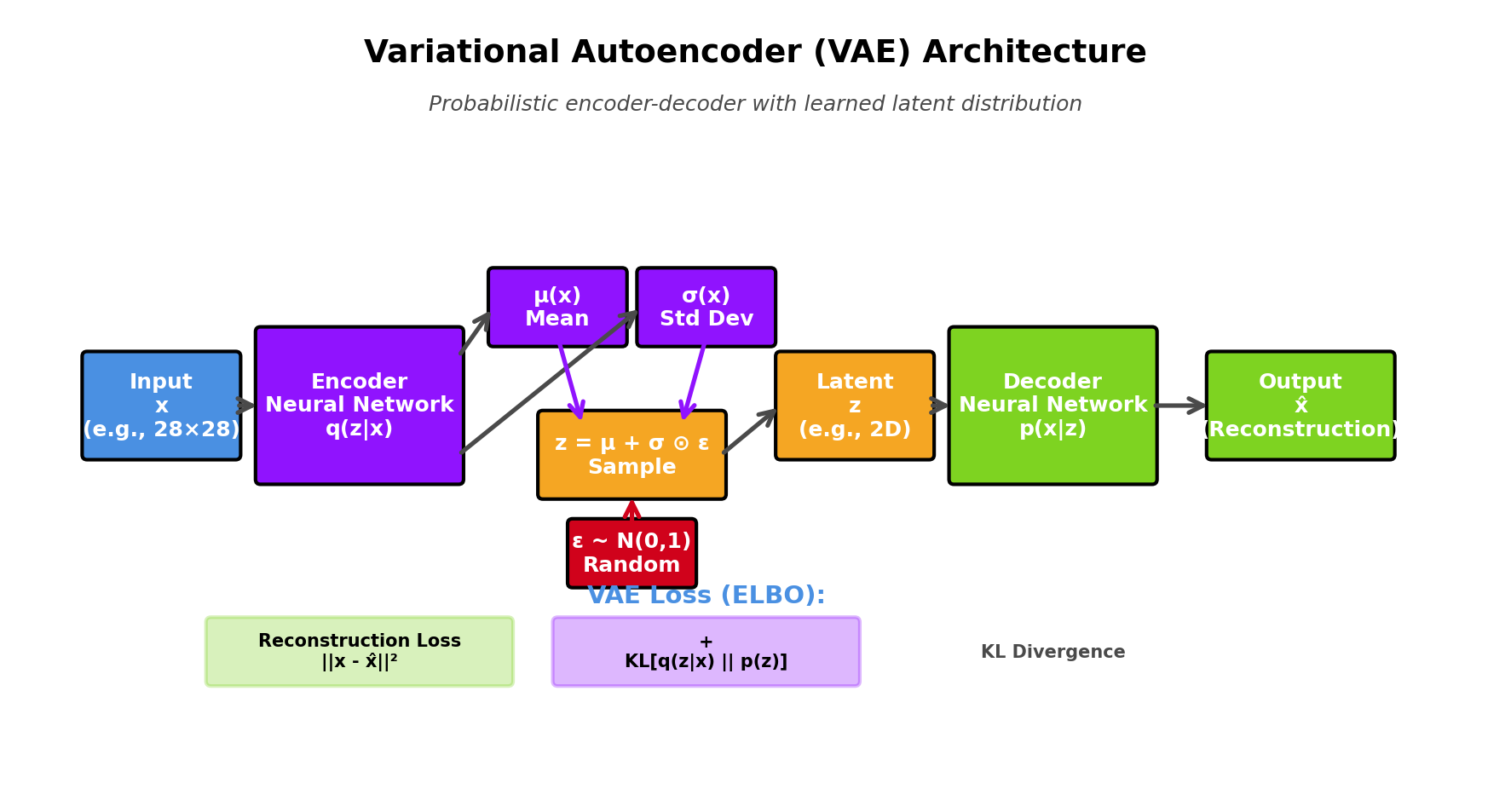
VAE insight: Encode data into a probability distribution in latent space, not a single point!
Architecture:
vbnet
Encoder: x → μ, σ (distribution parameters)
Latent: z ~ N(μ, σ²) (sample from distribution)
Decoder: z → x̂ (reconstruct)
Benefit: Smooth, continuous latent space
Probabilistic Formulation
Goal: Learn generative model P(x)
Latent variable model:
css
P(x) = ∫ P(x|z) * P(z) dz
Where:
- P(z): Prior distribution (standard normal N(0,I))
- P(x|z): Likelihood (decoder outputs)
- P(x): Marginal distribution (data probability)
Challenge: Computing P(x) requires intractable integral!
VAE solution: Use variational inference to approximate
Encoder: Inference Network
Encoder learns: Q(z|x) ~= P(z|x)
Parametrization:
css
Q(z|x) = N(μ(x), σ²(x))
Where:
- μ(x): Mean predicted by neural network
- σ(x): Standard deviation predicted by neural network
Example (MNIST):
python
class Encoder(nn.Module):
    def __init__(self, input_dim=784, latent_dim=20):
        super().__init__()
        self.fc1 = nn.Linear(input_dim, 400)
        self.fc_mu = nn.Linear(400, latent_dim)  # Mean
        self.fc_logvar = nn.Linear(400, latent_dim)  # Log variance

    def forward(self, x):
        h = F.relu(self.fc1(x))
        mu = self.fc_mu(h)
        logvar = self.fc_logvar(h)
        return mu, logvar
Decoder: Generative Network
Decoder learns: P(x|z)
Parametrization:
scss
P(x|z) = Bernoulli(π(z))  # For binary data
P(x|z) = N(μ(z), σ²)      # For continuous data
Example (MNIST):
python
class Decoder(nn.Module):
    def __init__(self, latent_dim=20, output_dim=784):
        super().__init__()
        self.fc1 = nn.Linear(latent_dim, 400)
        self.fc2 = nn.Linear(400, output_dim)

    def forward(self, z):
        h = F.relu(self.fc1(z))
        recon = torch.sigmoid(self.fc2(h))  # Bernoulli parameter
        return recon
The Reparameterization Trick
Problem
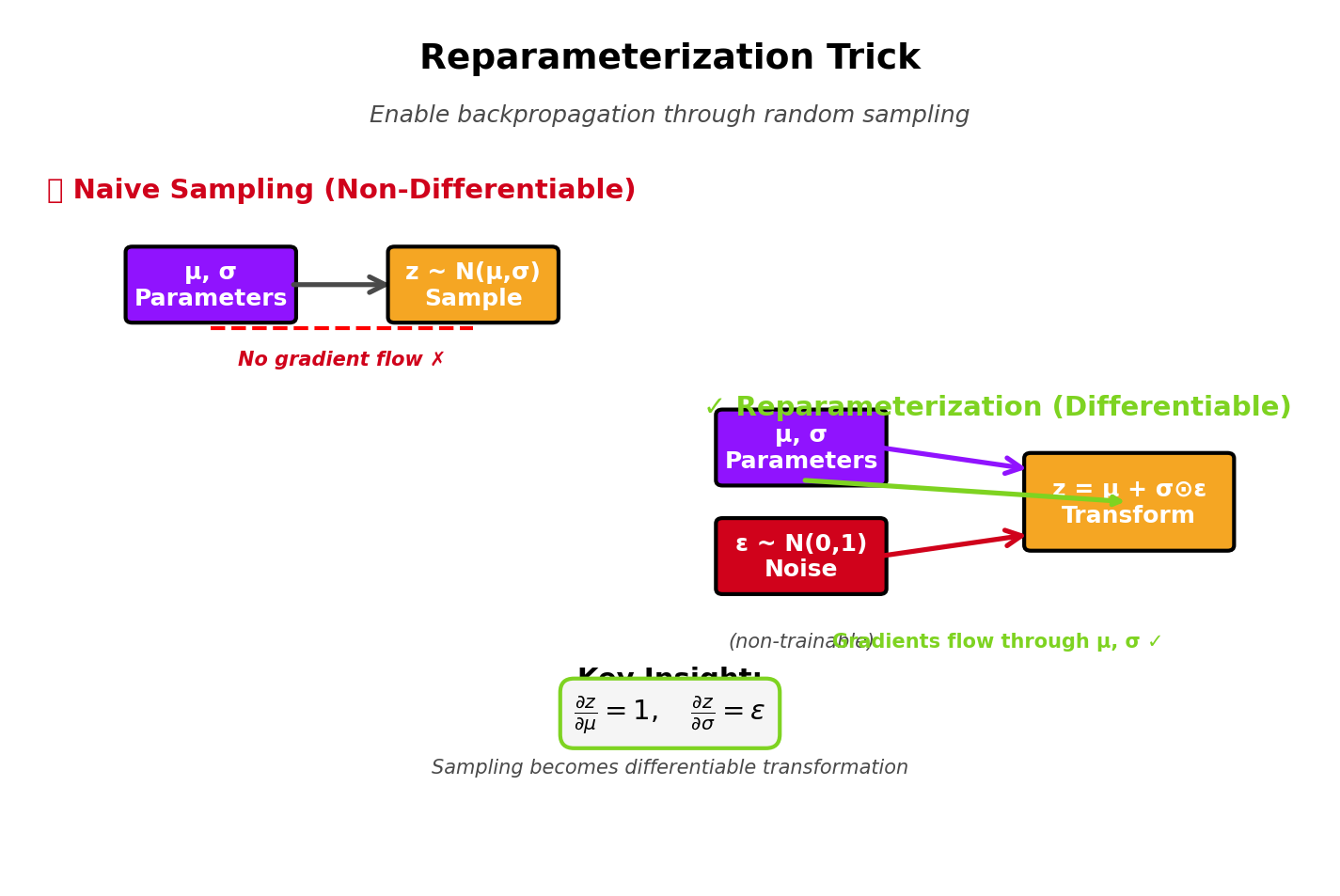
Naive sampling:
scss
z ~ N(μ, σ²)
Issue: Sampling is not differentiable! Can't backpropagate through random sampling.
Solution: Reparameterization
Reparameterize:
ini
z = μ + σ * ε, where ε ~ N(0, 1)
Why this works:
- ε: Random noise (no gradient needed)
- μ, σ: Deterministic (backprop flows through these!)
- z: Still distributed as N(μ, σ²)
Implementation:
python
def reparameterize(mu, logvar):
    std = torch.exp(0.5 * logvar)  # Convert log variance to std
    eps = torch.randn_like(std)    # Sample ε ~ N(0,1)
    z = mu + std * eps             # Reparameterize
    return z
Gradient flow:
markdown
Loss → Decoder → z → μ, σ → Encoder parameters ✓
                   ↓
                   ε (no gradient needed)
Evidence Lower Bound (ELBO)
Derivation
Goal: Maximize log P(x)
Variational inference:
css
log P(x) = ELBO + KL(Q(z|x) || P(z|x))
           ≥ ELBO  (since KL ≥ 0)
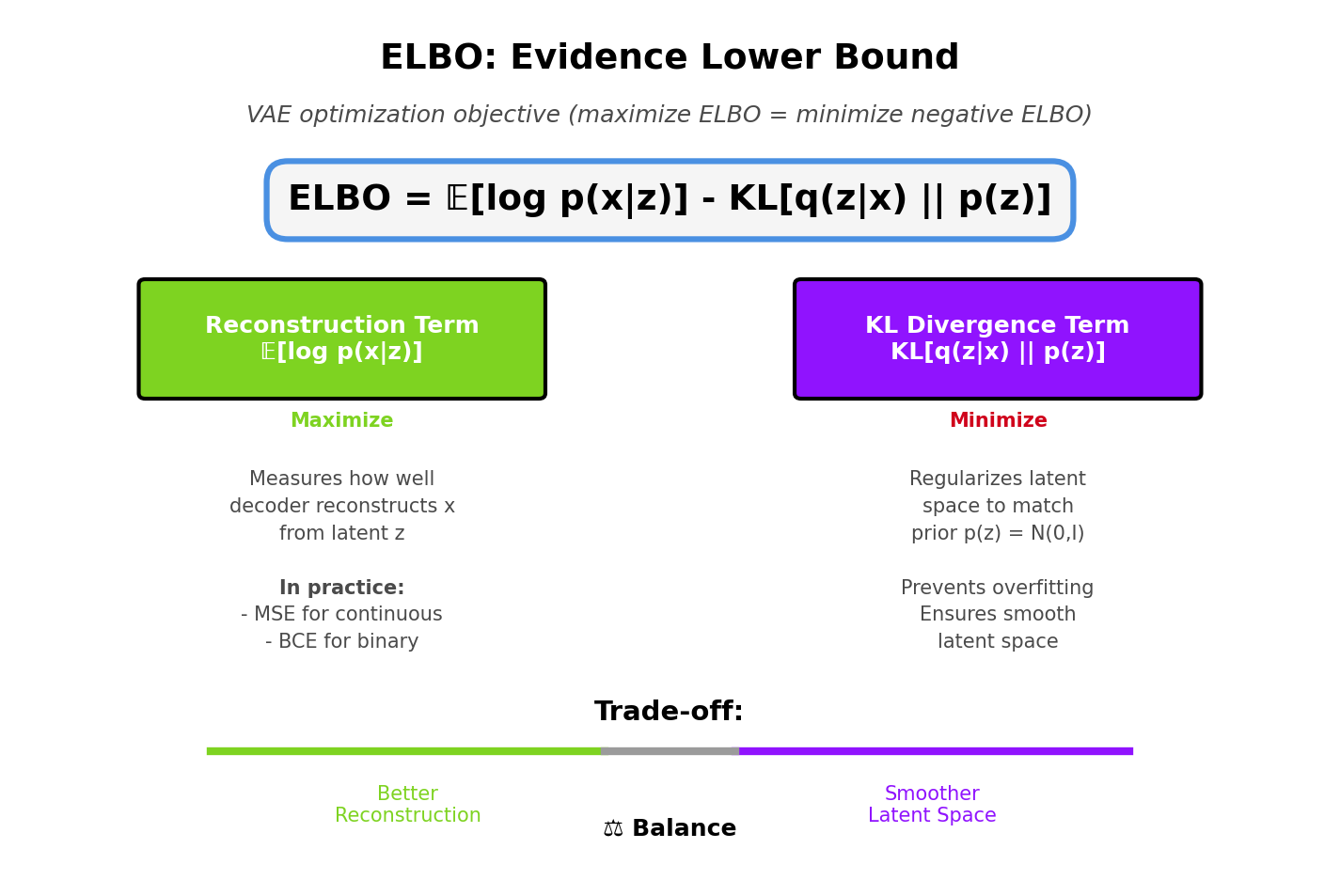
Evidence Lower Bound (ELBO):
scss
ELBO = E_Q[log P(x|z)] - KL(Q(z|x) || P(z))
        ↑                   ↑
   Reconstruction       Regularization
   (Decoder quality)    (Latent prior matching)
ELBO Components
One. Reconstruction Term
c
E_Q[log P(x|z)] = E[log P(x|z=μ+σε)]
For binary data (MNIST):
css
Reconstruction loss = Binary Cross-Entropy(x, x̂)
For continuous data:
css
Reconstruction loss = MSE(x, x̂)
2. KL Divergence Term
scss
KL(Q(z|x) || P(z)) = KL(N(μ,σ²) || N(0,I))
Closed-form solution:
ini
KL = 0.5 * Σ(1 + log(σ²) - μ² - σ²)
Loss Function
VAE loss (negative ELBO):
ini
Loss = Reconstruction Loss + KL Divergence
PyTorch implementation:
python
def vae_loss(x, recon_x, mu, logvar):
    # Reconstruction loss (BCE for binary data)
    recon_loss = F.binary_cross_entropy(recon_x, x, reduction='sum')

    # KL divergence loss
    kl_loss = -0.5 * torch.sum(1 + logvar - mu.pow(2) - logvar.exp())

    # Total loss
    return recon_loss + kl_loss
Complete VAE Implementation
python
import torch
import torch.nn as nn
import torch.nn.functional as F

class VAE(nn.Module):
    def __init__(self, input_dim=784, hidden_dim=400, latent_dim=20):
        super().__init__()

        # Encoder
        self.encoder_fc1 = nn.Linear(input_dim, hidden_dim)
        self.encoder_mu = nn.Linear(hidden_dim, latent_dim)
        self.encoder_logvar = nn.Linear(hidden_dim, latent_dim)

        # Decoder
        self.decoder_fc1 = nn.Linear(latent_dim, hidden_dim)
        self.decoder_fc2 = nn.Linear(hidden_dim, input_dim)

    def encode(self, x):
        h = F.relu(self.encoder_fc1(x))
        mu = self.encoder_mu(h)
        logvar = self.encoder_logvar(h)
        return mu, logvar

    def reparameterize(self, mu, logvar):
        std = torch.exp(0.5 * logvar)
        eps = torch.randn_like(std)
        return mu + eps * std

    def decode(self, z):
        h = F.relu(self.decoder_fc1(z))
        recon = torch.sigmoid(self.decoder_fc2(h))
        return recon

    def forward(self, x):
        mu, logvar = self.encode(x.view(-1, 784))
        z = self.reparameterize(mu, logvar)
        recon_x = self.decode(z)
        return recon_x, mu, logvar

    def sample(self, num_samples):
        # Sample from prior N(0,I)
        z = torch.randn(num_samples, self.latent_dim)
        samples = self.decode(z)
        return samples

# Training loop
model = VAE()
optimizer = torch.optim.Adam(model.parameters(), lr=1e-3)

for epoch in range(10):
    for batch_idx, (data, _) in enumerate(train_loader):
        optimizer.zero_grad()

        # Forward pass
        recon_batch, mu, logvar = model(data)

        # Compute loss
        loss = vae_loss(data.view(-1, 784), recon_batch, mu, logvar)

        # Backward pass
        loss.backward()
        optimizer.step()
Latent Space Exploration
Generating New Samples
Method 1: Sample from prior
python
z = torch.randn(num_samples, latent_dim)
generated_images = vae.decode(z)
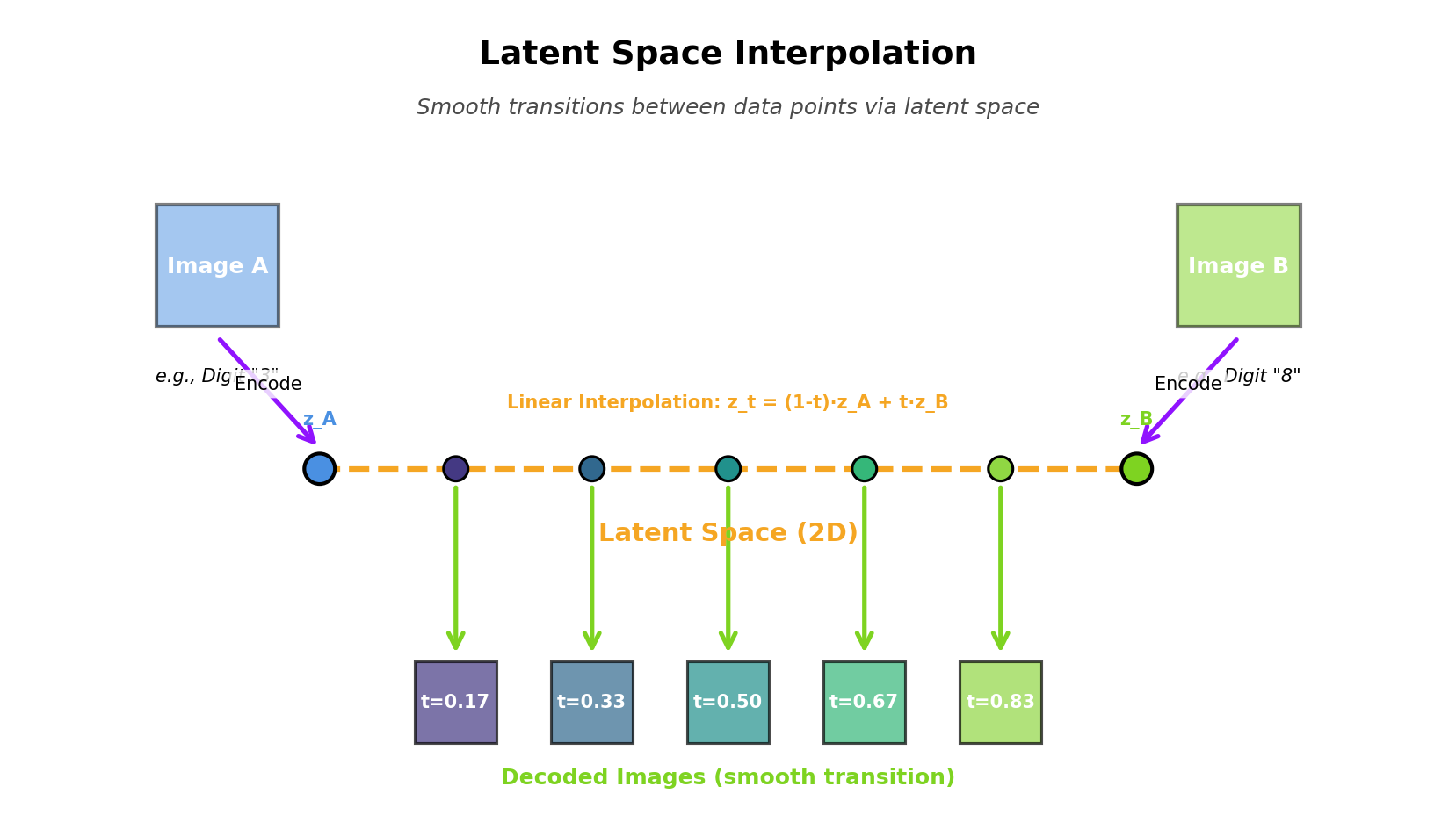
Method 2: Interpolation
python
# Encode two images
mu1, _ = vae.encode(image1)
mu2, _ = vae.encode(image2)

# Interpolate in latent space
alpha = np.linspace(0, 1, num=10)
interpolated_codes = [(1-a)*mu1 + a*mu2 for a in alpha]

# Decode interpolated codes
interpolated_images = [vae.decode(z) for z in interpolated_codes]
Latent Space Arithmetic
Famous example (faces):
ini
man_with_glasses = man + glasses - face
woman_smiling = woman + smile - neutral
MNIST example:
ini
# Average latent codes for each digit
z_3 = mean(latent_codes_for_digit_3)
z_8 = mean(latent_codes_for_digit_8)

# Arithmetic
z_blend = 0.5 * z_3 + 0.5 * z_8
blended_digit = vae.decode(z_blend)  # Might look like 3+8 hybrid
Latent Space Traversal
Explore individual latent dimensions:
python
z = torch.zeros(1, latent_dim)

# Vary one dimension
for value in np.linspace(-3, 3, num=10):
    z[0, 5] = value  # Vary dimension 5
    image = vae.decode(z)
    # Display image - see how dimension 5 affects output
Observation: Some dimensions control specific attributes (rotation, thickness, style)
β-VAE: Disentangled Representations
Motivation
Standard VAE: Latent dimensions may be entangled (correlated factors)
β-VAE: Encourage disentanglement (independent factors)
Modified Loss
β-VAE loss:
ini
Loss = Reconstruction Loss + β * KL Divergence
Where:
- β > 1: Stronger regularization
- Effect: More disentangled latent space
- Trade-off: Worse reconstructions
Typical β values: 1-10
Benefits of Disentanglement
Interpretable latent dimensions:
- Dimension 1: Digit identity
- Dimension 2: Rotation angle
- Dimension 3: Stroke thickness
- ...
Applications:
- Controllable generation
- Data editing (change specific attributes)
- Improved generalization
Conditional VAE (CVAE)
Motivation
Standard VAE: Can't control what to generate
CVAE: Condition generation on labels/attributes
Architecture
Encoder:
css
Q(z | x, y) # Condition on both image x and label y
Decoder:
css
P(x | z, y) # Generate image conditioned on label y
Implementation
python
class CVAE(nn.Module):
    def __init__(self, input_dim=784, label_dim=10, latent_dim=20):
        super().__init__()

        # Encoder (input = image + label)
        self.encoder_fc1 = nn.Linear(input_dim + label_dim, 400)
        self.encoder_mu = nn.Linear(400, latent_dim)
        self.encoder_logvar = nn.Linear(400, latent_dim)

        # Decoder (input = latent + label)
        self.decoder_fc1 = nn.Linear(latent_dim + label_dim, 400)
        self.decoder_fc2 = nn.Linear(400, input_dim)

    def encode(self, x, y):
        # Concatenate image and label
        xy = torch.cat([x, y], dim=1)
        h = F.relu(self.encoder_fc1(xy))
        mu = self.encoder_mu(h)
        logvar = self.encoder_logvar(h)
        return mu, logvar

    def decode(self, z, y):
        # Concatenate latent and label
        zy = torch.cat([z, y], dim=1)
        h = F.relu(self.decoder_fc1(zy))
        recon = torch.sigmoid(self.decoder_fc2(h))
        return recon

    def sample(self, y, num_samples):
        # Generate specific digit y
        z = torch.randn(num_samples, self.latent_dim)
        y_repeated = y.repeat(num_samples, 1)
        samples = self.decode(z, y_repeated)
        return samples
Usage
Generate specific digits:
python
# Generate 100 samples of digit "7"
y = F.one_hot(torch.tensor([7]), num_classes=10).float()
samples = cvae.sample(y, num_samples=100)
Applications
One. Image Generation
Generate new faces, bedrooms, objects
- CelebA dataset (faces)
- LSUN dataset (bedrooms)
2. Image-to-Image Translation
Style transfer:
- Photo -> Painting style
- Day -> Night
3. Anomaly Detection
Use reconstruction error:
css
If ||x - x̂||² > threshold: Anomaly
Applications:
- Medical imaging (detect tumors)
- Manufacturing (defect detection)
4. Data Compression
Compress to latent code (20-200 dimensions)
- Much smaller than original image (784 dimensions for MNIST)
5. Semi-Supervised Learning
Use VAE for feature learning:
- Encoder learns useful representations
- Use z as features for downstream tasks
Advantages of VAEs
- Principled training: Maximize likelihood (ELBO)
- Stable training: No adversarial dynamics
- Interpretable latent space: Smooth, continuous
- Fast sampling: Single forward pass through decoder
- Density estimation: Can compute P(x) approximately
Limitations of VAEs
- Blurry outputs: Reconstruction loss encourages averaging
- Limited expressiveness: Gaussian assumptions
- Posterior collapse: KL term can dominate, z ignored
- Worse sample quality than GANs: For complex data
Hyperparameters
| Parameter | Typical Value | Effect |
|---|---|---|
| Latent dimension | 10-200 | Smaller: compressed; Larger: expressive |
| Learning rate | 1e-3 to 1e-4 | Standard for VAEs |
| β (for β-VAE) | 1-10 | Higher: more disentanglement |
| Hidden layers | 1-3 layers | Deeper: more expressive |
| Hidden units | 128-512 | Larger: more capacity |
Key Takeaways
- VAEs learn latent probability distributions, not fixed codes
- Reparameterization trick enables gradient flow through sampling
- ELBO loss balances reconstruction and regularization
- Latent space is smooth and interpretable
- β-VAE encourages disentangled representations
- CVAE enables controlled generation
- Trade-offs: Stable training, blurry outputs vs GANs
Looking Ahead
- Lesson 11: GANs for higher-quality generation
- Lesson 12: Advanced GAN architectures (StyleGAN, ProGAN)
- Lesson 13: Diffusion models (current state-of-the-art)
Summary
- VAEs combine autoencoders with probabilistic modeling
- Encoder maps data to latent distribution parameters (μ, σ)
- Reparameterization trick enables backpropagation through sampling
- ELBO = Reconstruction + KL divergence
- Latent space allows interpolation and arithmetic
- β-VAE and CVAE extend VAEs for disentanglement and control
- Applications: Generation, translation, anomaly detection, compression