Concept 7: Multi-Armed Bandits and Exploration
Multi-Armed Bandits and Exploration
ℹ️ Definition Multi-Armed Bandits are a simplified reinforcement learning framework where an agent must choose among multiple actions (arms) to maximize cumulative reward, balancing exploration (trying new arms) and exploitation (pulling the best known arm).
Learning Objectives
By the end of this lesson, you will:
- Understand the multi-armed bandit problem and its real-world applications
- Learn exploration strategies (ε-greedy, UCB, Thompson Sampling)
- Implement bandit algorithms from scratch
- Extend to contextual bandits with state information
- Apply bandits to recommendation systems and A/B testing
- Understand when to use bandits vs full RL
Introduction
In Lessons 1-6, we studied full reinforcement learning with states, actions, rewards, and long-term planning:
vbnet
State → Action → Next State → Reward → ...
But what if there's no state? Just repeated choices between actions?
Multi-Armed Bandits are the simplest RL problem:
- No states (stateless)
- No delayed rewards (immediate feedback)
- Focus: Exploration vs Exploitation trade-off
This simplification enables powerful theoretical results and practical applications.
The Multi-Armed Bandit Problem
Slot Machine Analogy
Imagine a casino with K slot machines (one-armed bandits):
ini
🎰 Machine 1: Average payout = $0.50 (unknown)
🎰 Machine 2: Average payout = $0.80 (unknown)
🎰 Machine 3: Average payout = $0.20 (unknown)
...
🎰 Machine K: Average payout = $0.65 (unknown)
Goal: Maximize total money won over T plays.
Challenge: You don't know which machine is best!
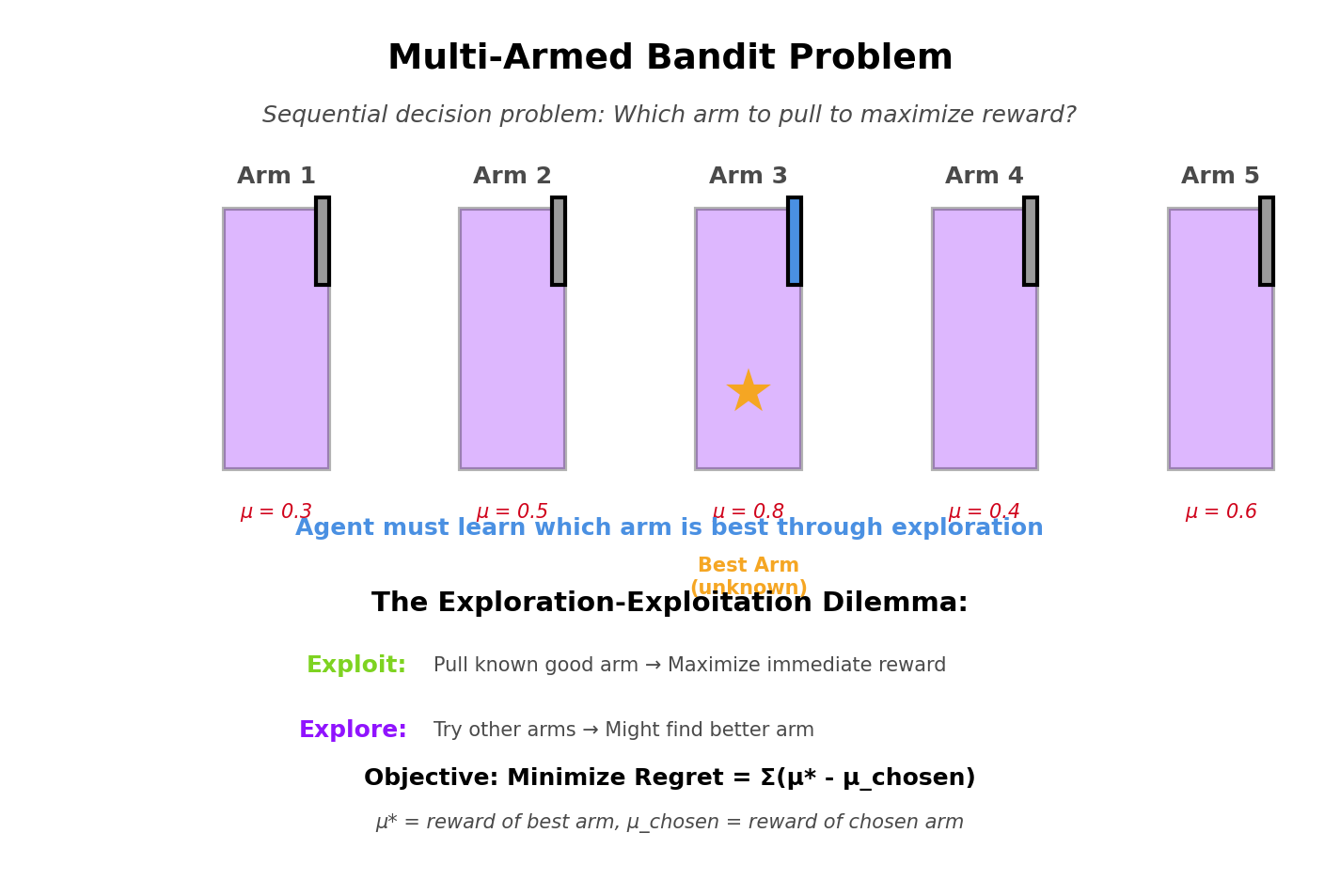
Formal Definition
Setup:
- K arms (actions)
- Each arm i has unknown reward distribution with mean μᵢ
- At each timestep t:
- Choose arm aₜ
- Observe reward rₜ ~ P(r | aₜ)
- Goal: Maximize cumulative reward Σ rₜ
Key Quantity: Regret = reward we could have achieved with perfect knowledge - actual reward
ini
Regret = T * μ* - Σₜ rₜ
Where μ* = max_i μᵢ (best arm's mean)
Why Bandits Matter
Simplicity enables:
- Theoretical guarantees: Provable regret bounds
- Efficient algorithms: Computationally cheap
- Fast learning: Simpler than full RL
Real-world applications:
- A/B testing: Which website design converts best?
- Ad placement: Which ad gets most clicks?
- Clinical trials: Which treatment works best?
- Recommendation systems: Which content keeps users engaged?
The Exploration-Exploitation Dilemma
The Core Trade-Off
Exploitation: Choose the best known arm (maximize immediate reward) Exploration: Try other arms to gain information (maximize long-term reward)
Example:
ini
Arm 1: Pulled 100 times, average reward = 0.8
Arm 2: Pulled 10 times, average reward = 0.9
Arm 3: Pulled 2 times, average reward = 1.0

Which arm to pull next?

Exploitation: Pull Arm 1 (most reliable estimate)
Exploration: Pull Arm 3 (uncertain, might be amazing!)
Exploration Strategies
We'll learn three main strategies:
- ε-Greedy: Random exploration with probability ε
- Upper Confidence Bound (UCB): Optimistic exploration
- Thompson Sampling: Bayesian probabilistic matching
ε-Greedy Algorithm
Idea
With probability ε: Explore (choose random arm) With probability 1-ε: Exploit (choose best arm)
Algorithm
python
Initialize:
  Q(a) = 0 for all arms (estimated values)
  N(a) = 0 for all arms (pull counts)

For t = 1, 2, ..., T:
  if random() < ε:
      aₜ = random arm     # Explore
  else:
      aₜ = argmax_a Q(a)  # Exploit

  rₜ = pull arm aₜ
  N(aₜ) += 1

  # Update estimate (incremental mean)
  Q(aₜ) ← Q(aₜ) + (1/N(aₜ)) * (rₜ - Q(aₜ))
Implementation
python
import numpy as np

class EpsilonGreedy:
    def __init__(self, n_arms, epsilon=0.1):
        self.n_arms = n_arms
        self.epsilon = epsilon
        self.Q = np.zeros(n_arms)  # Estimated values
        self.N = np.zeros(n_arms)  # Pull counts

    def select_arm(self):
        if np.random.random() < self.epsilon:
            return np.random.randint(self.n_arms)  # Explore
        else:
            return np.argmax(self.Q)  # Exploit

    def update(self, arm, reward):
        self.N[arm] += 1
        # Incremental update: Q_new = Q_old + (1/N) * (reward - Q_old)
        self.Q[arm] += (1 / self.N[arm]) * (reward - self.Q[arm])

# Example usage
bandit = EpsilonGreedy(n_arms=3, epsilon=0.1)
for t in range(1000):
    arm = bandit.select_arm()
    reward = env.pull(arm)  # Get reward from environment
    bandit.update(arm, reward)
Epsilon Decay
Often, we want more exploration early and less later:
python
epsilon_t = epsilon_0 * (decay_rate ** t)

# Example: Start at ε=1.0, end at ε=0.01
epsilon_0 = 1.0
decay_rate = 0.995
epsilon_min = 0.01
epsilon_t = max(epsilon_min, epsilon_0 * (decay_rate ** t))
Strengths and Weaknesses
Strengths:
- ✅ Simple to understand and implement
- ✅ Works well in practice
- ✅ Guaranteed to converge (with epsilon decay)
Weaknesses:
- ❌ Explores randomly (no smart exploration)
- ❌ Sensitive to epsilon choice
- ❌ Doesn't account for uncertainty (all non-greedy arms treated equally)
Upper Confidence Bound (UCB)
Idea
Be optimistic in the face of uncertainty:
- Estimate not just the mean reward, but also uncertainty
- Choose arm with highest upper confidence bound
scss
UCB(a) = Q(a) + c * sqrt(log(t) / N(a))
          ↑           ↑
       Exploitation  Exploration bonus
Where:
- Q(a): Estimated mean reward of arm a
- N(a): Number of times arm a pulled
- t: Total timesteps
- c: Exploration constant (typically c=2)
Intuition
Exploration bonus grows when:
- Arm pulled rarely (N(a) small -> bonus large)
- Many other arms pulled (t large -> bonus increases)
Effect: Automatically balances exploration and exploitation!
Algorithm
python
For t = 1, 2, ..., T:
  # Select arm with highest upper confidence bound
  aₜ = argmax_a [Q(a) + c * sqrt(log(t) / N(a))]

  rₜ = pull arm aₜ
  N(aₜ) += 1
  Q(aₜ) ← Q(aₜ) + (1/N(aₜ)) * (rₜ - Q(aₜ))
Implementation
python
class UCB:
    def __init__(self, n_arms, c=2.0):
        self.n_arms = n_arms
        self.c = c
        self.Q = np.zeros(n_arms)
        self.N = np.zeros(n_arms)
        self.t = 0

    def select_arm(self):
        self.t += 1

        # Pull each arm once first
        if np.any(self.N == 0):
            return np.argmin(self.N)

        # Compute UCB for each arm
        ucb_values = self.Q + self.c * np.sqrt(np.log(self.t) / self.N)
        return np.argmax(ucb_values)

    def update(self, arm, reward):
        self.N[arm] += 1
        self.Q[arm] += (1 / self.N[arm]) * (reward - self.Q[arm])
Theoretical Guarantee
UCB Regret Bound:
r
Regret ≤ O(sqrt(K * T * log(T)))
Where:
- K: Number of arms
- T: Time horizon
Interpretation: UCB has sublinear regret (regret grows slower than T).
Strengths and Weaknesses
Strengths:
- ✅ Principled exploration (based on uncertainty)
- ✅ No hyperparameter tuning needed (epsilon-free)
- ✅ Theoretical guarantees
Weaknesses:
- ❌ Assumes bounded rewards
- ❌ Can be conservative (over-explores)
- ❌ Doesn't naturally extend to contextual bandits
Thompson Sampling
Idea
Bayesian approach: Maintain probability distribution over arm values, sample from distributions.
Algorithm:
- Maintain belief distribution P(μₐ | data) for each arm a
- Sample estimate μ̃ₐ ~ P(μₐ | data) for each arm
- Pull arm with highest sample: aₜ = argmax_a μ̃ₐ
Beta Distribution (Bernoulli Bandits)
For binary rewards 0, 1:
- Prior: Beta(α, β) distribution
- Update: After observing reward r:
- If r = 1: α <- α + 1 (success)
- If r = 0: β <- β + 1 (failure)
Beta distribution properties:
- Mean = α / (α + β)
- Variance decreases as α + β increases (less uncertain over time)
Algorithm
python
For t = 1, 2, ..., T:
  # Sample from each arm's belief distribution
  for arm a:
      μ̃ₐ ~ Beta(αₐ, βₐ)

  # Choose arm with highest sample
  aₜ = argmax_a μ̃ₐ

  rₜ = pull arm aₜ

  # Update belief
  if rₜ == 1:
      αₐₜ ← αₐₜ + 1
  else:
      βₐₜ ← βₐₜ + 1
Implementation
python
class ThompsonSampling:
    def __init__(self, n_arms):
        self.n_arms = n_arms
        self.alpha = np.ones(n_arms)  # Success counts (Beta prior α)
        self.beta = np.ones(n_arms)   # Failure counts (Beta prior β)

    def select_arm(self):
        # Sample from each arm's Beta distribution
        samples = np.random.beta(self.alpha, self.beta)
        return np.argmax(samples)

    def update(self, arm, reward):
        # Update belief (Beta posterior)
        if reward == 1:
            self.alpha[arm] += 1
        else:
            self.beta[arm] += 1

# For continuous rewards, use Gaussian distribution
class ThompsonSamplingGaussian:
    def __init__(self, n_arms):
        self.n_arms = n_arms
        self.mu = np.zeros(n_arms)    # Mean estimates
        self.sigma = np.ones(n_arms)  # Uncertainty
        self.N = np.zeros(n_arms)

    def select_arm(self):
        # Sample from each arm's Gaussian belief
        samples = np.random.normal(self.mu, self.sigma)
        return np.argmax(samples)

    def update(self, arm, reward):
        self.N[arm] += 1
        # Update mean (incremental average)
        self.mu[arm] += (1 / self.N[arm]) * (reward - self.mu[arm])
        # Decrease uncertainty
        self.sigma[arm] = 1 / np.sqrt(self.N[arm])
Strengths and Weaknesses
Strengths:
- ✅ Principled Bayesian approach
- ✅ Often best empirical performance
- ✅ Naturally handles uncertainty
- ✅ Extends well to contextual bandits
Weaknesses:
- ❌ Computationally more expensive (sampling)
- ❌ Requires choosing prior distribution
- ❌ Less intuitive than ε-greedy
Contextual Bandits
Motivation
Standard bandits: No state, choose same arm every time if it's best.
Contextual bandits: Have state (context), best arm depends on context.
Example - News Recommendation:
yaml
Standard bandit: Recommend same article to everyone
Contextual bandit:
  - Context: User age, location, interests
  - Action: Recommend article
  - Reward: Click or no click
  - Goal: Personalize recommendations
Formal Definition
Setup:
- At each timestep t:
- Observe context xₜ (e.g., user features)
- Choose arm aₜ based on context
- Observe reward rₜ
- Goal: Learn policy π(x) that maps contexts to arms
Linear Contextual Bandits
Assumption: Reward is linear in context features:
css
E[r | x, a] = xᵀ θₐ
Where:
- x: Context vector (features)
- θₐ: Weight vector for arm a (learned)
LinUCB Algorithm
Extends UCB to contextual settings:
python
class LinUCB:
    def __init__(self, n_arms, context_dim, alpha=1.0):
        self.n_arms = n_arms
        self.alpha = alpha

        # For each arm, maintain:
        self.A = [np.eye(context_dim) for _ in range(n_arms)]  # AᵀA
        self.b = [np.zeros(context_dim) for _ in range(n_arms)]  # Aᵀr

    def select_arm(self, context):
        ucb_values = []

        for a in range(self.n_arms):
            # Compute weight estimate
            A_inv = np.linalg.inv(self.A[a])
            theta_a = A_inv @ self.b[a]

            # Predicted reward
            pred_reward = context @ theta_a

            # Uncertainty bonus
            uncertainty = self.alpha * np.sqrt(context @ A_inv @ context)

            # UCB
            ucb = pred_reward + uncertainty
            ucb_values.append(ucb)

        return np.argmax(ucb_values)

    def update(self, arm, context, reward):
        self.A[arm] += np.outer(context, context)
        self.b[arm] += reward * context
Neural Contextual Bandits
For complex contexts (images, text), use neural networks:
python
class NeuralBandit:
    def __init__(self, context_dim, n_arms):
        self.network = nn.Sequential(
            nn.Linear(context_dim, 128),
            nn.ReLU(),
            nn.Linear(128, 64),
            nn.ReLU(),
            nn.Linear(64, n_arms)  # Output: expected reward for each arm
        )
        self.optimizer = optim.Adam(self.network.parameters())

    def select_arm(self, context, epsilon=0.1):
        if np.random.random() < epsilon:
            return np.random.randint(self.n_arms)

        with torch.no_grad():
            context_tensor = torch.FloatTensor(context)
            q_values = self.network(context_tensor)
            return q_values.argmax().item()

    def update(self, context, arm, reward):
        context_tensor = torch.FloatTensor(context)
        q_values = self.network(context_tensor)

        # MSE loss for chosen arm
        target = q_values.clone()
        target[arm] = reward
        loss = F.mse_loss(q_values, target)

        self.optimizer.zero_grad()
        loss.backward()
        self.optimizer.step()
Applications
A/B Testing
Problem: Test K website designs, find best one.
Bandit approach:
- Arms: Website designs
- Reward: Click-through rate
- Algorithm: Thompson Sampling (fast convergence)
Benefit over fixed A/B test: Adaptively shifts traffic to better design.
Recommendation Systems
Problem: Recommend content to users.
Contextual bandit approach:
- Context: User features (age, location, history)
- Arms: Content items
- Reward: Click, watch time, rating
- Algorithm: LinUCB or Neural Bandit
Example - News:
python
# User context
context = [age=25, location=USA, interests=["tech", "sports"]]

# Select article
article = neural_bandit.select_arm(context)

# Observe engagement
reward = 1 if user_clicked else 0

# Update model
neural_bandit.update(context, article, reward)
Clinical Trials
Problem: Test K treatments, minimize patient harm.
Bandit approach:
- Arms: Treatments
- Reward: Patient outcome
- Algorithm: Thompson Sampling (Bayesian, ethical)
Benefit: Adaptive trial design minimizes exposure to inferior treatments.
Online Advertising
Problem: Choose which ad to show.
Contextual bandit:
- Context: User profile, page content
- Arms: Ads
- Reward: Click, conversion
- Algorithm: LinUCB
Scale: Billions of decisions per day.
Bandits vs Full RL
When to Use Bandits
Use bandits when:
- No delayed rewards: Immediate feedback
- Stateless or independent contexts: No sequential dependencies
- Fast learning required: Need quick convergence
- Simple structure: Don't need long-term planning
Examples: A/B testing, ad selection, recommendation systems
When to Use Full RL
Use full RL when:
- Delayed rewards: Actions have long-term consequences
- Sequential states: Current action affects future states
- Planning required: Need to consider multi-step strategies
- Complex dynamics: Environment has intricate state transitions
Examples: Robotics, game playing, autonomous driving
Hybrid Approaches
Contextual Bandits + RL:
- Model state transitions with RL
- Model immediate reward with bandits
- Example: YouTube recommendations (session-level RL, video-level bandits)
Key Takeaways
- Multi-armed bandits focus on exploration-exploitation trade-off without states
- ε-Greedy explores randomly with probability ε
- UCB uses optimistic uncertainty bonuses for principled exploration
- Thompson Sampling samples from belief distributions (Bayesian)
- Contextual bandits extend to state-dependent action selection
- Applications: A/B testing, recommendations, ads, clinical trials
- Bandits vs RL: Bandits for immediate feedback, RL for sequential decisions
Looking Ahead
- Lesson 8: RL in practice (debugging, deployment, reward shaping)
- Lessons 9-15: Generative AI fundamentals
- Lesson 16: RLHF uses bandit/RL concepts for LLM alignment!
Summary
- Multi-armed bandits are stateless RL problems focused on exploration vs exploitation
- ε-Greedy explores randomly (simple but effective)
- UCB uses uncertainty bonuses (principled, provable regret bounds)
- Thompson Sampling uses Bayesian belief distributions (best empirical performance)
- Contextual bandits extend to state-dependent decisions
- Applications include A/B testing, recommendations, ads, clinical trials
- Bandits complement full RL for problems with immediate feedback and no state dependencies