Concept 5: Actor-Critic Methods
Actor-Critic Methods
ℹ️ Definition Actor-Critic Methods combine value-based and policy-based reinforcement learning by using a critic to evaluate actions (reducing variance) while an actor learns the policy (enabling continuous actions and stochastic policies).
Learning Objectives
By the end of this lesson, you will:
- Understand how actor-critic combines the best of value-based and policy-based RL
- Learn the advantage function and its role in variance reduction
- Implement A2C (Advantage Actor-Critic) from scratch
- Understand A3C (Asynchronous Actor-Critic) for parallel training
- Apply actor-critic methods to continuous control tasks
- Debug bias-variance trade-offs in actor-critic training
Introduction
In Lesson 4, we learned policy gradients (REINFORCE), which directly optimize policies but suffer from high variance:
c
∇J = E[Σ_t ∇ log π(a_t|s_t) * G_t]
        ↑
    Very noisy!
In Lessons 2-3, we learned value-based methods (Q-Learning, DQN), which are sample-efficient but can't handle continuous actions.
Actor-Critic methods get the best of both worlds by combining them.
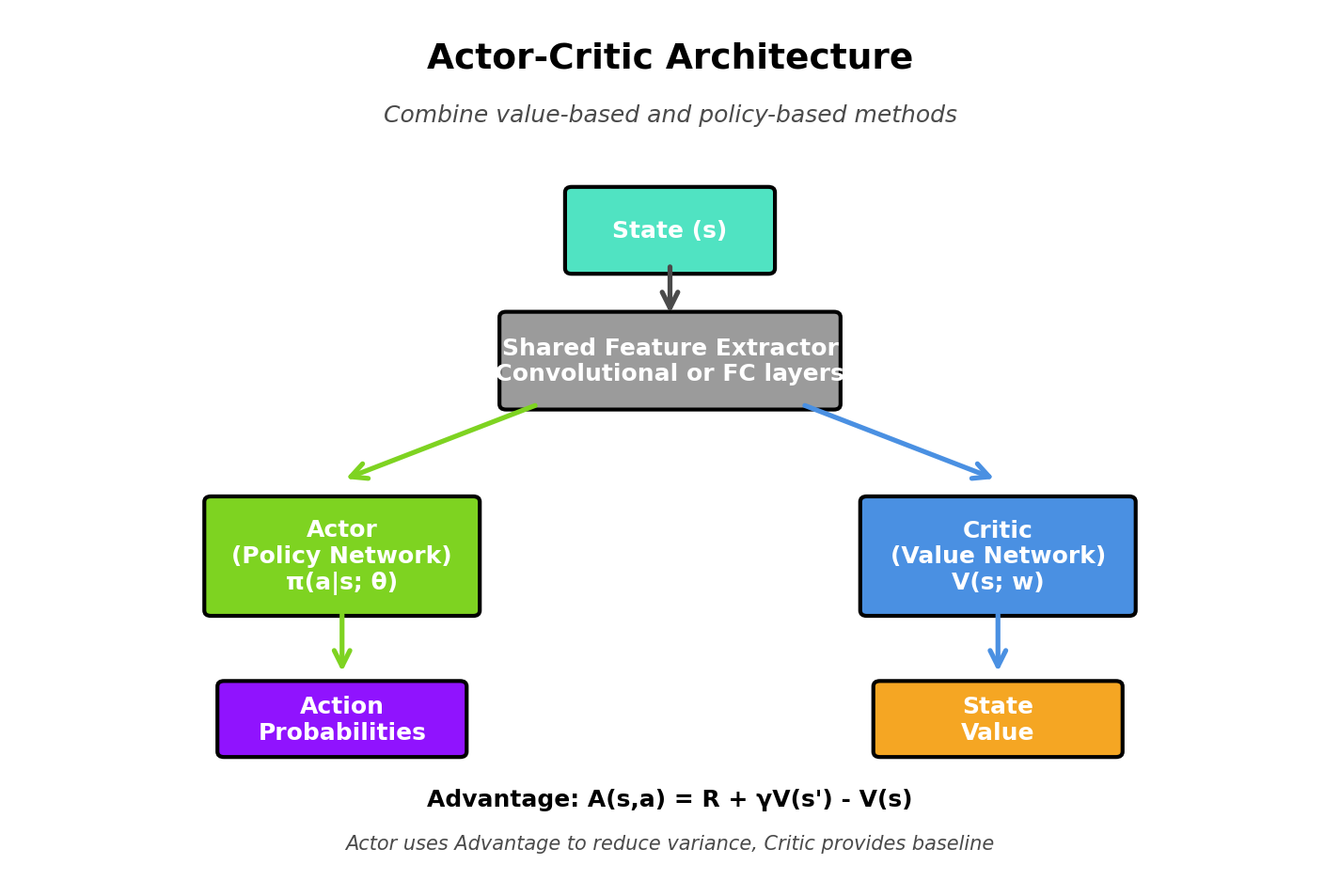
The Actor-Critic Architecture
Two Networks
Actor: Policy network π(a|s; θ)
- Role: Choose actions
- Training: Policy gradient updates
- Output: Action (discrete or continuous)
Critic: Value network V(s; w)
- Role: Evaluate how good states are
- Training: Temporal difference learning (like Q-Learning)
- Output: State value V(s)
Information Flow
scss
          State s
             ↓
    ┌────────┴────────┐
    ↓                 ↓
  Actor           Critic
π(a|s;θ)         V(s;w)
    ↓                 ↓
  Action a        Value V(s)
    ↓
 Environment
    ↓
Reward r, Next State s'
    ↓
TD Error: δ = r + γV(s') - V(s)
    ↓
Update Actor (policy gradient with δ)
Update Critic (minimize TD error)
Advantage Function
Definition
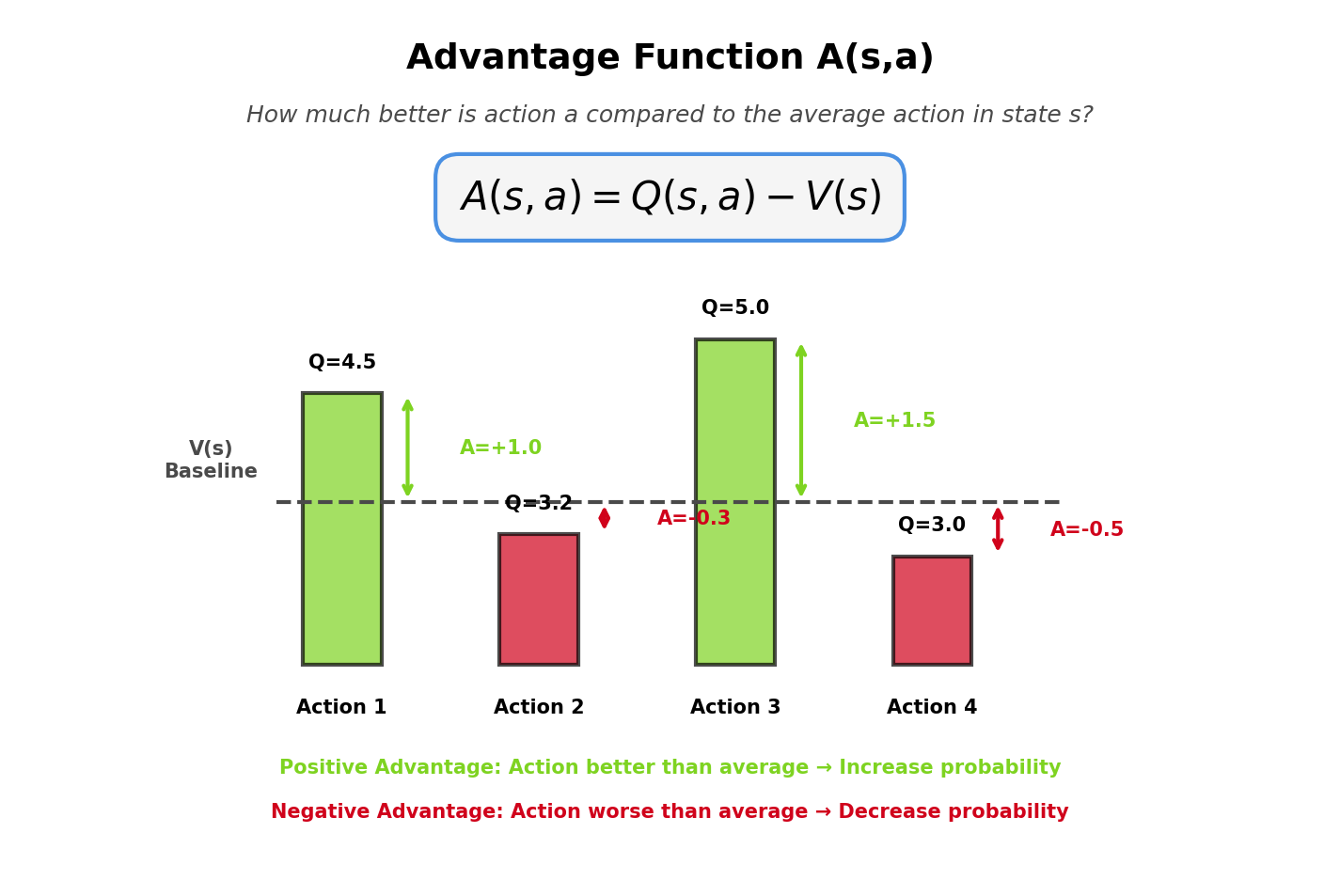
The advantage function measures how much better an action is compared to average:
css
A(s,a) = Q(s,a) - V(s)
Where:
- Q(s,a): Value of taking action a in state s
- V(s): Average value of state s
- A(s,a): Advantage of action a (positive = better than average)
Why Advantages?
Problem with raw returns:
python
# Episode 1: G = 100 (good!)
# Episode 2: G = 95 (also good, but lower)
# Policy gradient: Decrease probability of Episode 2 actions ❌
Solution with advantages:
python
# Baseline V(s) = 90
# Episode 1: A = 100 - 90 = +10 (increase probability ✓)
# Episode 2: A = 95 - 90 = +5 (increase probability ✓)
# Both episodes better than average!
Advantage Estimation
We don't have Q(s,a) directly, but we can estimate it:
TD Error as Advantage:
scss
δ_t = r_t + γV(s_{t+1}) - V(s_t)
This is an unbiased estimate of the advantage:
arduino
E[δ_t] = Q(s_t, a_t) - V(s_t) = A(s_t, a_t)
Intuition:
- r_t + γV(s_t+1): One-step estimate of Q(s_t, a_t)
- V(s_t): Baseline
- δ_t: How much better/worse the action was than expected
Actor-Critic Algorithm
Basic Algorithm
python
Initialize actor π(a|s; θ) and critic V(s; w)
Set learning rates α_θ (actor), α_w (critic)

for episode in range(num_episodes):
    s = env.reset()
    done = False

    while not done:
        # Actor: Select action
        a ~ π(·|s; θ)

        # Environment: Take action
        s', r, done = env.step(a)

        # Critic: Compute TD error
        if done:
            δ = r - V(s; w)
        else:
            δ = r + γ * V(s'; w) - V(s; w)

        # Update Critic (minimize TD error)
        w ← w + α_w * δ * ∇_w V(s; w)

        # Update Actor (policy gradient with advantage)
        θ ← θ + α_θ * δ * ∇_θ log π(a|s; θ)

        s = s'
PyTorch Implementation
python
import torch
import torch.nn as nn
import torch.optim as optim
import torch.distributions as distributions

class Actor(nn.Module):
    def __init__(self, state_dim, action_dim):
        super().__init__()
        self.fc1 = nn.Linear(state_dim, 128)
        self.fc2 = nn.Linear(128, 128)
        self.fc3 = nn.Linear(128, action_dim)

    def forward(self, state):
        x = torch.relu(self.fc1(state))
        x = torch.relu(self.fc2(x))
        logits = self.fc3(x)
        return logits

    def select_action(self, state):
        logits = self.forward(state)
        probs = torch.softmax(logits, dim=-1)
        dist = distributions.Categorical(probs)
        action = dist.sample()
        log_prob = dist.log_prob(action)
        return action.item(), log_prob

class Critic(nn.Module):
    def __init__(self, state_dim):
        super().__init__()
        self.fc1 = nn.Linear(state_dim, 128)
        self.fc2 = nn.Linear(128, 128)
        self.fc3 = nn.Linear(128, 1)

    def forward(self, state):
        x = torch.relu(self.fc1(state))
        x = torch.relu(self.fc2(x))
        value = self.fc3(x)
        return value

# Initialize networks
actor = Actor(state_dim=4, action_dim=2)
critic = Critic(state_dim=4)
actor_optimizer = optim.Adam(actor.parameters(), lr=0.001)
critic_optimizer = optim.Adam(critic.parameters(), lr=0.005)

# Training loop
for episode in range(1000):
    state = env.reset()
    done = False

    while not done:
        # Actor selects action
        state_tensor = torch.FloatTensor(state)
        action, log_prob = actor.select_action(state_tensor)

        # Environment step
        next_state, reward, done, _ = env.step(action)
        next_state_tensor = torch.FloatTensor(next_state)

        # Critic evaluates
        value = critic(state_tensor)
        next_value = critic(next_state_tensor) if not done else torch.tensor(0.0)

        # Compute TD error (advantage)
        td_target = reward + gamma * next_value
        td_error = td_target - value

        # Update Critic
        critic_loss = td_error.pow(2)
        critic_optimizer.zero_grad()
        critic_loss.backward()
        critic_optimizer.step()

        # Update Actor
        actor_loss = -log_prob * td_error.detach()  # Detach to prevent backprop through critic
        actor_optimizer.zero_grad()
        actor_loss.backward()
        actor_optimizer.step()

        state = next_state
A2C (Advantage Actor-Critic)
Motivation
Basic actor-critic updates after every step (online learning):
- ✅ Low variance (uses baseline)
- ❌ High computational overhead (many gradient updates)
- ❌ Doesn't leverage parallelism
A2C collects experiences over multiple steps/environments before updating.
N-Step Returns
Instead of 1-step TD error, use n-step returns for better credit assignment:
1-step return:
scss
G_t^(1) = r_t + γV(s_{t+1})
N-step return:
scss
G_t^(n) = r_t + γr_{t+1} + γ²r_{t+2} + ... + γ^n V(s_{t+n})
Advantage:
scss
A_t^(n) = G_t^(n) - V(s_t)
Bias-Variance Trade-off:
- n=1: Low variance, high bias
- n=large: High variance, low bias
- Typical: n=5 to n=20
A2C Algorithm
python
Initialize actor π(a|s; θ) and critic V(s; w)

for iteration in range(num_iterations):
    # Collect trajectories from environment
    trajectories = []
    for _ in range(num_actors):  # Parallel environments
        trajectory = collect_trajectory(env, actor, n_steps=20)
        trajectories.append(trajectory)

    # Compute n-step returns and advantages
    for trajectory in trajectories:
        for t, (s_t, a_t, r_t) in enumerate(trajectory):
            # N-step return
            G_t = Σ_{k=0}^{n-1} γ^k * r_{t+k} + γ^n * V(s_{t+n})

            # Advantage
            A_t = G_t - V(s_t)

    # Batch update actor and critic
    actor_loss = -Σ_t log π(a_t|s_t) * A_t
    critic_loss = Σ_t (G_t - V(s_t))²

    update(actor, critic, actor_loss, critic_loss)
Benefits of A2C
- Batching: Updates use multiple experiences (more stable gradients)
- Parallelism: Can run multiple environments simultaneously
- N-step returns: Better credit assignment than 1-step TD
- Synchronous: All workers update at same time (reproducible)
A3C (Asynchronous Actor-Critic)
Motivation
A2C requires synchronization (all workers finish before update).
A3C allows asynchronous updates: each worker updates global parameters independently.
Architecture
markdown
         Global Actor & Critic
         θ_global, w_global
                ↑  ↓
        ┌───────┴───────┬───────┐
        ↓               ↓       ↓
    Worker 1        Worker 2  Worker N
      θ₁, w₁          θ₂, w₂    θₙ, wₙ
        ↓               ↓         ↓
      Env 1           Env 2     Env N
Algorithm
python
# Global networks (shared)
global_actor = Actor()
global_critic = Critic()

# Worker thread
def worker(worker_id):
    # Local networks (copy of global)
    local_actor = Actor()
    local_critic = Critic()

    while not done:
        # 1. Sync with global
        local_actor.load_state_dict(global_actor.state_dict())
        local_critic.load_state_dict(global_critic.state_dict())

        # 2. Collect trajectory
        trajectory = collect_trajectory(env, local_actor, n_steps=20)

        # 3. Compute gradients locally
        actor_gradients, critic_gradients = compute_gradients(trajectory)

        # 4. Update global networks asynchronously
        with lock:
            global_actor.apply_gradients(actor_gradients)
            global_critic.apply_gradients(critic_gradients)

# Launch multiple workers
threads = [Thread(target=worker, args=(i,)) for i in range(num_workers)]
for t in threads:
    t.start()
A3C vs A2C
| Aspect | A2C | A3C |
|---|---|---|
| Updates | Synchronous (wait for all) | Asynchronous (independent) |
| Reproducibility | Deterministic | Stochastic (thread timing) |
| GPU Utilization | Better (batched updates) | Worse (many small updates) |
| Implementation | Simpler | More complex (threading) |
| Modern Practice | Preferred | Historical interest |
Consensus: A2C is now preferred due to better GPU utilization and reproducibility.
Generalized Advantage Estimation (GAE)
Motivation
Trade-off between bias and variance:
- 1-step advantage: Low variance, high bias
- N-step advantage: High variance, low bias
GAE uses an exponentially-weighted average of all n-step advantages.
Formula
scss
GAE(λ) = (1-λ) * [A^(1) + λ*A^(2) + λ²*A^(3) + ...]
Where:
- λ ∈ [0, 1]: Decay parameter
- λ=0: 1-step advantage (low variance, high bias)
- λ=1: Monte Carlo return (high variance, low bias)
- λ=0.95: Typical value (good balance)
Implementation
python
def compute_gae(rewards, values, next_value, gamma=0.99, lam=0.95):
    advantages = []
    gae = 0

    # Iterate backwards through trajectory
    for t in reversed(range(len(rewards))):
        if t == len(rewards) - 1:
            next_val = next_value
        else:
            next_val = values[t + 1]

        # TD error
        delta = rewards[t] + gamma * next_val - values[t]

        # GAE recursion
        gae = delta + gamma * lam * gae
        advantages.insert(0, gae)

    return advantages
Continuous Action Spaces
Gaussian Actor
For continuous control:
python
class GaussianActor(nn.Module):
    def __init__(self, state_dim, action_dim):
        super().__init__()
        self.fc1 = nn.Linear(state_dim, 128)
        self.fc2 = nn.Linear(128, 128)
        self.mean = nn.Linear(128, action_dim)
        self.log_std = nn.Parameter(torch.zeros(action_dim))

    def forward(self, state):
        x = torch.relu(self.fc1(state))
        x = torch.relu(self.fc2(x))
        mean = self.mean(x)
        std = torch.exp(self.log_std)
        return mean, std

    def select_action(self, state):
        mean, std = self.forward(state)
        dist = torch.distributions.Normal(mean, std)
        action = dist.sample()
        log_prob = dist.log_prob(action).sum()
        return action, log_prob
Entropy Regularization
Problem
Actor may become deterministic too early, stopping exploration.
Solution
Add entropy bonus to encourage exploration:
python
entropy = -(probs * torch.log(probs)).sum()
actor_loss = -log_probs * advantages - entropy_coef * entropy
Where:
- entropy_coef: Typically 0.01
- Higher entropy: More random policy (exploration)
- Lower entropy: More deterministic policy (exploitation)
Hyperparameters
| Parameter | Typical Value | Effect |
|---|---|---|
| Actor learning rate | 0.0001 - 0.001 | Lower than critic (more stable) |
| Critic learning rate | 0.001 - 0.01 | Higher than actor (learn faster) |
| Discount factor γ | 0.95 - 0.99 | Future reward valuation |
| N-steps | 5 - 20 | Longer: less bias, more variance |
| GAE λ | 0.9 - 0.99 | Advantage estimation smoothness |
| Entropy coefficient | 0.01 - 0.1 | Exploration encouragement |
Common Issues
Issue 1: Critic Learns Slowly
Symptom: Advantages don't shrink, actor updates are noisy.
Fix: Increase critic learning rate (2-10x actor learning rate).
Issue 2: Policy Collapse
Symptom: Policy becomes deterministic and performs poorly.
Fix: Increase entropy coefficient (0.01 -> 0.05).
Issue 3: Instability
Symptom: Performance oscillates wildly.
Fixes:
- Reduce learning rates
- Use gradient clipping
- Normalize advantages
Advantages of Actor-Critic
- Lower variance than policy gradients (baseline from critic)
- Continuous actions (from actor)
- Online learning (no need for full episodes)
- Bias-variance trade-off (tunable with n-steps, GAE)
- Parallelizable (A2C/A3C with multiple environments)
Limitations of Actor-Critic
- More complex than pure policy gradients
- Two networks to tune (separate learning rates)
- Biased estimates (from value function bootstrap)
- Still sample inefficient compared to off-policy methods
Key Takeaways
- Actor-critic combines policy gradients (actor) with value estimation (critic)
- Advantage function reduces variance by using critic as baseline
- A2C uses n-step returns and parallel environments
- GAE trades off bias and variance in advantage estimation
- Continuous control handled with Gaussian policies
- Entropy regularization maintains exploration
Looking Ahead
Actor-critic methods significantly improve upon vanilla policy gradients, but still have challenges:
- Lesson 6: PPO adds trust region constraints for more stable learning
- Lesson 7: Multi-armed bandits for specialized exploration
- Lesson 8: Debugging and deployment of RL agents
Next lesson: Learn how PPO became the gold standard for policy optimization!
Summary
- Actor-critic methods use two networks: actor (policy) and critic (value function)
- Advantage function A(s,a) = Q(s,a) - V(s) reduces variance without bias
- A2C collects trajectories from parallel environments and updates in batches
- N-step returns and GAE trade off bias and variance
- Continuous actions handled naturally with Gaussian actor policies
- Entropy regularization prevents premature convergence to deterministic policies